You woke up, looked out the window, and the street is white. Or you didn't sleep at all and you're refreshing your phone at 5:15 AM looking for any sign of an official announcement. Either way, the question is the same: is it a snow day today?
This guide covers exactly how to find out — right now — whether your school is cancelled, why the decision happens so fast on storm mornings, and what conditions your district is actually looking at. No fluff, no filler. Just the answers you need when you need them most.
Is School Closed Today? — Check Right Now
The fastest ways to confirm a snow day today, in order of speed:
- AI Snow Day Calculator: Enter your ZIP code at the Snow Day Calculator to see a live probability score pulled from the current NWS forecast and your district's history. Updated every hour.
- Your district's parent notification app: ParentSquare, SchoolMessenger, Remind, and similar platforms push closure alerts before 6:00 AM. Check your app's notification tray first.
- District website: Most schools post a homepage banner or alert bar when closed. Bookmark it now if you haven't.
- Local TV news station website: Search "[your city] school closings" — stations maintain live closure lists pulled directly from district feeds.
- Local radio: AM news stations read closure lists on air starting around 5:30 AM and update continuously.
Why Snow Days Are Called on Short Notice
It might feel like snow day decisions are last-minute scrambles, but the reality is more structured — and the "short notice" is intentional. Here's why announcements always land between 5 and 6:30 AM rather than the night before:
- Road conditions change overnight. A storm can intensify or weaken by 3–4 AM. Locking in a decision the previous evening based on an imprecise forecast costs districts instructional days unnecessarily — or puts kids on dangerous buses when the call should have been to close.
- DOT reports aren't available until pre-dawn. State department of transportation road condition systems update their treatment and traction reports starting around 2:30–3:00 AM. Superintendents use this data.
- Bus garage inspections happen at 4 AM. Transportation directors physically check whether buses start and confirm lot conditions before signing off on safe operations.
- The NWS issues a midnight update. The National Weather Service releases a revised forecast package around midnight. This is the single most important data point for next-morning decisions — it reflects the latest model runs and any overnight storm behavior.
All of this means the decision is genuinely unknowable until early morning — which is exactly why AI snow day tools update overnight and why the most accurate predictions happen after midnight.
How Districts Decide: The Morning Decision Chain
Understanding this chain tells you exactly when to check and what you're waiting for:
- Midnight – 2:00 AM: NWS issues updated overnight forecast. Superintendent monitors from home if a storm is expected.
- 2:30 – 3:30 AM: Transportation director reviews state DOT road condition maps for the district's bus routes. Key routes in rural and hilly areas are checked first.
- 3:30 – 4:30 AM: Bus garage supervisor inspects lot conditions and confirms vehicle readiness. Reports back to transportation director.
- 4:30 – 5:15 AM: Superintendent makes the final call — open, delay, or close. This is the decision window. Everything before this is data gathering.
- 5:15 – 5:45 AM: Automated notification system fires. Robocalls begin, app alerts push, TV station closure feeds receive the data.
- 5:45 – 6:30 AM: Local TV morning shows begin reading closures on air. District website updates. Closure aggregator sites reflect the decision.
"We're not guessing at 5 AM — we already know what the roads look like from three sources. The call itself takes about 90 seconds. It's everything before it that takes hours." — Transportation Director, suburban Ohio school district
This is why refreshing a closure page at 4:45 AM usually returns nothing — the decision literally hasn't been finalized yet.
Today's Closure Thresholds by Region
Whether today qualifies as a snow day depends almost entirely on where you live. The same storm means very different things to a Georgia superintendent versus one in Minnesota. Here's a region-by-region breakdown of the snowfall and temperature thresholds that typically trigger closures:
| Region | Snow Closure Threshold | Cold/Wind Chill Threshold | Ice Sensitivity |
|---|---|---|---|
| Deep South (GA, AL, MS, SC) | 1–2 inches forecast | Below 15°F at bus time | Very high — any ice = closure |
| Mid-Atlantic (VA, NC, TN, KY) | 2–4 inches | Below 10°F | High — ice often more decisive than snow |
| Northeast (NY, NJ, CT, MA, PA) | 4–8 inches | Below 0°F wind chill | Moderate — urban areas plow fast |
| Midwest (OH, IN, IL, MI, IA) | 5–8 inches | Below -15°F wind chill | Moderate |
| Upper Midwest (MN, WI, ND, SD) | 8–12+ inches | Below -25°F wind chill | Low — prepared for snow, more sensitive to extreme cold |
| Mountain West (CO, UT, ID, MT) | 6–10 inches | Below -10°F | High — ice on grades and mountain roads |
| Pacific Northwest (WA, OR) | 2–4 inches | Below 20°F | Very high — hilly terrain, limited plowing |
| Texas / Oklahoma / Arkansas | 1–3 inches (or any ice) | Below 20°F | Extremely high — minimal winter road infrastructure |
To know precisely where today's conditions land for your district, enter your ZIP code into the Snow Day Calculator — it applies these regional weights automatically and scores today's NWS data against your specific area's patterns.
2-Hour Delay vs. Full Snow Day: What's the Difference?
When Districts Choose a Delay
A 2-hour delay is the middle ground between a full snow day and normal operations. Districts use it when:
- Snow is still falling at decision time but expected to taper before 8 AM
- Roads are being treated but crews need more time on secondary streets
- Temperatures are below freezing but not extreme enough for a full closure
- The district has already used most of its allotted snow days for the year
A delay shifts bus pickup times back by 2 hours, giving road crews and conditions a chance to improve. School still happens — just later. Parents need to arrange childcare or supervision for the extra morning hours.
When a Full Closure Is Called Instead
Superintendents skip the delay option and go straight to closure when:
- Snowfall is forecast to continue through mid-morning with no clearing window
- Ice accumulation is significant and improving conditions are unlikely by 10 AM
- Wind chills are dangerously low and are expected to remain that way all day
- Visibility is severely reduced (blizzard conditions)
- Rural bus routes are completely impassable
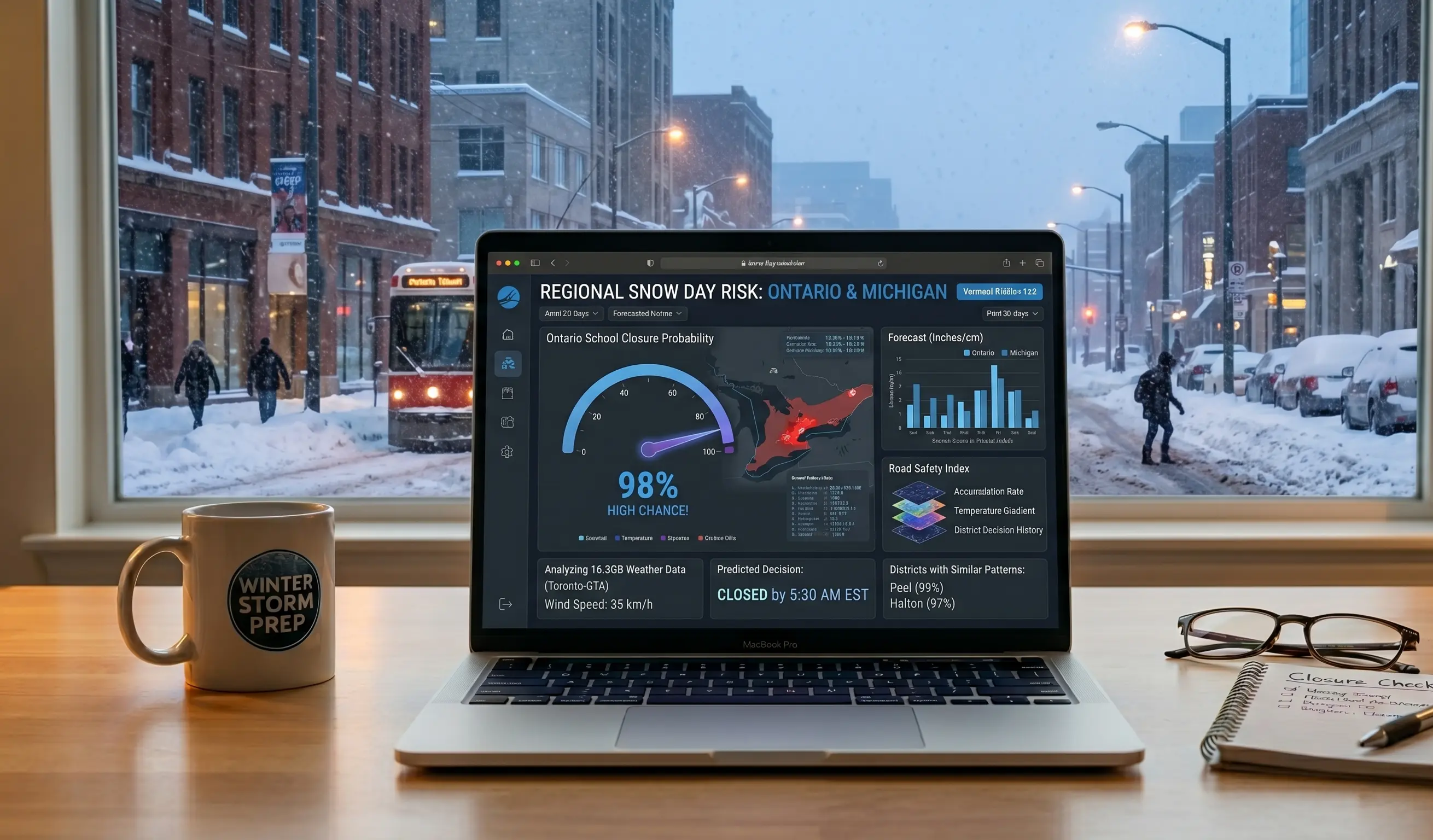
Today snow day calculation.
How to Get Notified the Moment a Decision Is Made
The best way to know about a snow day today is to already have notifications set up before storm season. Here's how to make sure you never miss an announcement:
- Parent portal / school app: Log into your district's parent portal (often PowerSchool, Infinite Campus, or Skyward) and confirm your mobile number is current. Opt into all weather and closure alert categories.
- ParentSquare / SchoolMessenger / Remind: If your district uses one of these platforms, download the app and enable push notifications. These hit your phone before email and before TV.
- Local TV station alerts: Stations like CBS, NBC, and ABC affiliates have apps with school closure push notifications. Search "[your city] news app" and turn on school alert notifications.
- Google or Alexa routines: Set a morning routine that reads local weather and says "check [district name] closings" — hands-free, no phone-staring at 5 AM.
- District Twitter/X: Many superintendents post closure decisions on the district's official social account simultaneously with robocalls. A quick follow puts it in your feed.
What to Do on a Snow Day Today
If the snow day is confirmed, here's how to make the most of it — practically speaking:
- Check for virtual learning assignments: Many districts now assign asynchronous work on snow days rather than making them up at the end of the year. Check the student portal or class app by 9 AM.
- Confirm childcare if needed: If both parents work, activate your backup childcare plan early — other families in your network are making the same calls right now.
- Watch for an early dismissal update: On borderline weather days, a closure sometimes flips to a delayed start or the reverse. Stay subscribed to alerts through mid-morning.
- Check the next-day forecast: Back-to-back snow days happen when storms stretch over 48 hours or roads refreeze overnight. Run the Snow Day Calculator again tonight for tomorrow's probability.
- Know the make-up day policy: Most districts track snow days against their state-mandated minimum instruction hours. After a set number (usually 3–5 days), make-up days come out of spring break or extend the school year.
Snow days are rare enough in most regions that they still carry a little magic — but the morning scramble to confirm one doesn't have to be chaotic. The right notifications, the right tools, and knowing exactly when to check makes the whole thing a lot smoother.