Canadian parents deal with some of the most extreme and variable winter weather on the planet — from Metro Vancouver's occasional centimetres of snowfall that shut down entire school boards to Prairie wind chills that close schools with zero precipitation. Predicting whether school will be cancelled requires a different approach than U.S.-based tools, because Canadian school boards operate under provincial authority with their own policies, contracted bus operators, and closure thresholds built over decades of local experience.
This guide explains how Canadian snow day predictions work, what thresholds look like province by province, how bus cancellations differ from full closures, and what six verified historical events tell us about real board behaviour. If you want the probability for tomorrow, enter your postal code in the calculator.
How to Check If School Is Cancelled Today in Canada
Most parents searching at 5 AM need an answer fast. Here are the primary channels Canadian boards use to announce closures, in order of reliability:
- Your school board's website: The authoritative source. Most boards post closure notices on their homepage by 6:00–6:30 AM. Bookmark your specific board's site — not a provincial page. Major Ontario boards each post independently: Toronto District School Board (TDSB), Peel District School Board, York Region District School Board, and Ottawa-Carleton District School Board (OCDSB), among others.
- SchoolMessenger / parent notification apps: Many Canadian public boards use SchoolMessenger or similar systems to push automated calls, texts, and emails to registered parents. Register before winter — the sign-up page is typically under "Communications" on your board's website.
- CBC Radio regional stations: CBC Radio regional broadcasts carry school closure lists throughout the morning. Local commercial stations run the same lists.
- Provincial bus operator portals: In Ontario, regional student transportation consortia operate separate portals that post bus cancellations independently from school closure decisions. This is the most commonly missed step — see the next section for why this matters.
- Social media: Most boards post simultaneously to X (formerly Twitter) and Facebook. Search your board's verified handle for real-time updates.
- Environment Canada warnings: Active ECCC Winter Storm Warnings and Extreme Cold Warnings for your region often precede board announcements and are a strong signal that a closure decision is under review.
Bus Cancellation vs Full School Closure: The Critical Difference
This is the single most confusing aspect of Canadian school weather decisions, and it catches families off guard every winter. Canada's contracted bus operator system means two separate organizations can issue two different verdicts for the same storm morning.
| Scenario | Bus Transportation | School Buildings | Who Is Affected | Typical Weather Trigger |
|---|---|---|---|---|
| Bus cancellation only | Suspended | Open | Bus-dependent students; rural families | Extreme wind chill / hazardous rural roads |
| Full school closure | Suspended | Closed | All students and staff | Blizzard / major accumulation / extreme cold |
| Delayed start | Delayed 1–2 hrs | Open (late) | All students, later arrival | Early-morning ice / storm clearing by 9 AM |
| Early dismissal | Early departure | Closes mid-day | All students | Storm developing mid-day / freezing rain onset |
Prairie province boards have the most formalized two-tier system. In Manitoba, Winnipeg School Division and surrounding boards routinely cancel buses while keeping school buildings open — meaning a student who lives a short distance from school attends while a rural student on a long bus route stays home. The snow day probability calculator outputs separate scores for bus cancellation and full closure when wind chill is the primary hazard, because these are genuinely different outcomes requiring different planning responses.
How the Snow Day Calculator Works for Canadian Schools
Canadian snow day prediction is technically harder than U.S. prediction for two structural reasons: school closure authority is decentralized across a large number of publicly funded boards across the country, and wind chill must be treated as a primary closure variable rather than a secondary modifier — something most tools built for U.S. audiences do not do at all.
The prediction pipeline for a Canadian postal code operates in five stages:
- Postal code to board mapping: Your postal code resolves to the boards serving your area. In cities like Toronto and Ottawa, multiple boards with different closure histories operate in overlapping geography — each is modelled separately, which is why a TDSB probability and a Toronto Catholic DSB probability for the same address may differ.
- ECCC HRDPS grid-point data: Environment Canada's High Resolution Deterministic Prediction System (HRDPS) provides hourly forecasts at 2.5 km grid spacing across most of Canada — local precision rather than regional averages. This is the primary forecast source, checked against weather.gc.ca model runs.
- Wind chill as a primary variable: Unlike most U.S. tools, the Canadian model weights wind chill as a first-order closure trigger, not a modifier. ECCC's wind chill guidelines define frostbite risk thresholds that Canadian boards use as policy anchors — this is built into the model's Prairie and northern Ontario predictions.
- ECCC warning integration: Active Environment Canada Winter Storm Warnings, Blizzard Warnings, and Extreme Cold Warnings raise the probability score substantially — Canadian boards treat official ECCC warnings as near-automatic triggers for reviewing closure decisions.
- Historical board-level calibration: Observed closure decisions from individual boards are matched to comparable historical weather conditions to calibrate output probabilities. See the data sources page for technical detail on weather input sourcing.
Snow Day Thresholds by Province and School Board
The table below represents approximate closure thresholds based on observed historical board decisions, publicly stated transportation policies where available, and patterns from documented winter events. No official cross-Canada threshold database is published by any provincial government — these figures represent observed patterns, not guaranteed policy. Individual boards vary year to year.
| Province / Region | Snowfall Threshold (approx.) | Ice / Freezing Rain | Wind Chill Trigger | Official Board Resources |
|---|---|---|---|---|
| BC — Metro Vancouver / Lower Mainland | 5–10 cm | Any accumulation | Approx. −10°C or colder | VSB · Surrey Schools · SD43 Coquitlam |
| BC — Interior (Kelowna, Kamloops) | 15–25 cm | Significant ice | Approx. −20°C or colder | SD23 Central Okanagan · SD73 Kamloops |
| Alberta — Calgary / Edmonton | Significant overnight accumulation | Significant ice | Approx. −40°C wind chill | CBE Calgary · Edmonton Public |
| Alberta — Northern (Grande Prairie, Fort McMurray) | Heavy accumulation | Significant ice | Approx. −45°C wind chill | Alberta Education |
| Saskatchewan — Regina / Saskatoon | Heavy accumulation or blizzard conditions | Significant ice | Approx. −40°C to −45°C wind chill | Regina Public · Saskatoon Public |
| Manitoba — Winnipeg | Heavy accumulation or visibility <400m | Significant ice | Approx. −40°C wind chill (bus cancellation trigger) | Winnipeg School Division |
| Ontario — GTA (Toronto, Peel, York, Durham) | Significant overnight snowfall | Any significant ice | Approx. −25°C to −30°C wind chill | TDSB · Peel DSB · York RDSB |
| Ontario — Southwestern (London, Windsor) | Significant accumulation or lake-effect event | Any significant ice | Approx. −25°C wind chill | Thames Valley DSB · Windsor-Essex CDSB |
| Ontario — Northern (Thunder Bay, Sudbury) | Heavy accumulation | Significant ice | Approx. −35°C to −40°C wind chill | Lakehead DSB · Rainbow DSB |
| Quebec — Montreal / Laval | Significant overnight accumulation | Any significant ice | Approx. −30°C wind chill | CSDM · EMSB |
| Nova Scotia — Halifax / HRM | Heavy wind-driven accumulation | Any significant ice | Approx. −25°C wind chill | Halifax Regional Centre for Education |
| New Brunswick / PEI | Significant accumulation | Any significant ice | Approx. −30°C wind chill | NB Education · PEI Education |
Thresholds are approximate ranges based on observed closure patterns over multiple winters. Year-to-year variation is significant. Source: observed board decisions matched to ECCC weather records and publicly stated board transportation policies where available. Always verify with your board's official communications.
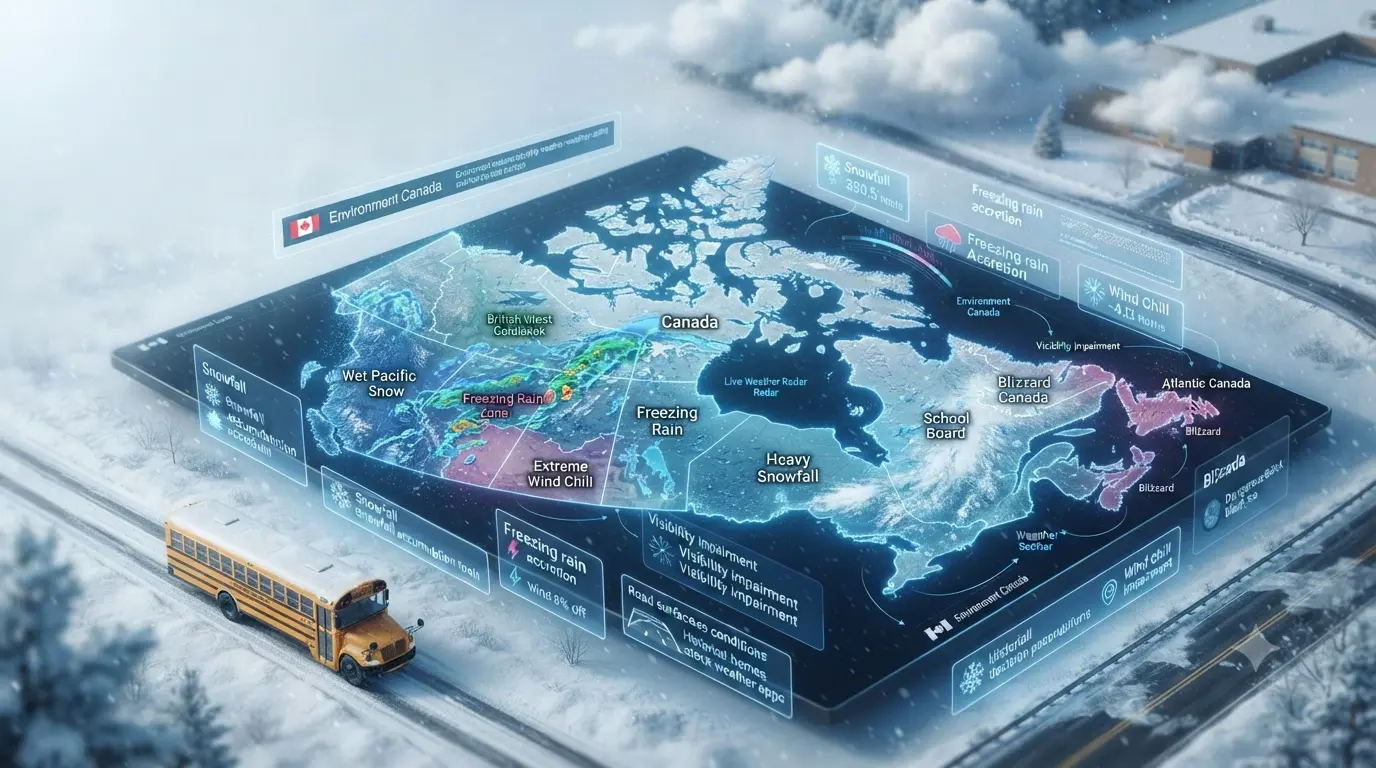
Heavy snowfall on a Canadian school bus route — the type of conditions that push Prairie boards past their overnight accumulation thresholds. Bus operators conduct their own road assessments and often make the first closure recommendation.
Wind Chill Closures: Canada's Unique Cold-Weather Policy
One category of school cancellation largely unique to Canada is the pure wind chill closure: school cancelled with zero precipitation, solely because temperatures are dangerously cold. A Canadian snow day calculator that does not model wind chill as a primary variable will systematically underpredict closures in Prairie and northern communities.
The Science Behind the Threshold
Canada uses the ECCC Wind Chill Index, a joint standard developed with the United States National Weather Service, to calculate what cold air combined with wind feels like on exposed skin. The index was updated in 2001 and is based on heat loss models using a standardized walking pace and average adult face.
According to Health Canada's cold weather safety guidance, the risk of frostbite on exposed skin increases significantly at lower wind chill values. At −40°C wind chill, frostbite can occur within roughly 10 minutes on exposed skin — the physiological basis for many Prairie school board policies. Children waiting at rural bus stops with no shelter face this exposure directly.
The Extreme Cold Warning is ECCC's formal threshold alert for dangerous wind chill, typically issued when wind chill values are expected to reach −40°C or colder (thresholds vary by region — ECCC publishes regional warning criteria). When such a warning is active for your area, Prairie and northern boards treat it as a near-automatic trigger for reviewing transportation decisions.
How Wind Chill Policies Work in Prairie Provinces
Alberta, Saskatchewan, and Manitoba school boards have among the most formalized wind chill policies of any school systems globally. Many operate on the two-tier bus cancellation / full closure system described earlier. Edmonton Public Schools, Calgary Board of Education, and Winnipeg School Division are among the larger boards with publicly documented cold-weather transportation policies. These policies are updated periodically — confirm your specific board's current threshold with their transportation page rather than relying on any third-party guide, including this one.
Wind Chill in Ontario and Quebec
Southern Ontario and Quebec boards are less formalized in wind chill policy than Prairie boards, but extreme cold still drives decisions. When Environment Canada issues an Extreme Cold Warning for a region, boards with long rural bus routes frequently cancel or suspend transportation even without a formal written threshold. Northern Ontario boards — Thunder Bay, Sudbury, Sault Ste. Marie — operate in communities with genuinely extreme temperatures and have developed consistent operational norms that make their cold-weather decisions more predictable than their southern counterparts, though still less formalized than Prairie boards.
Quick Reference: Wind Chill and What It Means for Schools
| Wind Chill (°C) | ECCC Risk Level | Typical School Impact |
|---|---|---|
| −28 to −39 | High risk | Frostbite possible in 10–30 min on exposed skin. Southern boards may issue delays on long rural routes. |
| −40 to −47 | Very high risk; ECCC warning likely | Frostbite can occur in under 10 min. Many Prairie boards cancel bus service at or near this range. |
| −48 and colder | Extreme; ECCC warning in effect | Frostbite in minutes. Full school closure common in Prairie and northern communities. |
Risk descriptions based on ECCC Wind Chill Index guidance and Health Canada cold weather safety. School impact thresholds are observed patterns, not guaranteed policy.
Methodology: What This Analysis Is and Is Not
Before the event-by-event breakdown, here is exactly what this analysis did and did not do.
What we did not do: This is not a live-captured audit of any specific tool's output before each storm. The assessments below are reconstructed from public forecast archives and confirmed closure records. They illustrate structural strengths and weaknesses in closure prediction logic — not a precisely measured accuracy rate from a controlled study.
Pulled verified ECCC weather records from climate.weather.gc.ca for each event date and location
Confirmed board closure decisions against official announcements and contemporaneous CBC News regional coverage
Identified the primary closure driver per event: snowfall total, ice accumulation, wind chill, blizzard visibility, or preemptive board decision
Assessed tool performance gap: where a snowfall-only tool would have missed the closure and where Canadian-specific modelling (wind chill, board history) would have added accuracy
Selected events across 6 geographically distinct regions covering all major closure driver types — not to produce a favourable result, but to represent the full range of Canadian winter weather scenarios
Sample size caveat: Six events is a non-random illustrative sample. The patterns below are directional — they demonstrate structural tendencies in how different closure drivers interact with regional board behaviour, not a statistically representative national accuracy rate.
6 Verified Canadian Snow Day Events (2019–2024)
Six documented winter weather events across Canada, each sourced from public archives, each illustrating something specific about regional board behaviour:
Toronto "Snowmageddon" — The Board Divergence Event
A significant snowfall combined with strong winds hit the GTA. Peel District School Board and York District School Board cancelled. The Toronto District School Board — Canada's largest board by enrolment — stayed open, per CBC Toronto. This event became a reference point for why board identity matters more than city in Ontario. A tool applying a single "Toronto" threshold would have been wrong for at least one of those boards. TDSB's documented reluctance to cancel is now a standard calibration input for any Ontario-specific model.
Source: CBC Toronto — Toronto Snowmageddon School Closures, February 2019
Winnipeg Extreme Cold — Zero Precipitation, School Cancelled
Wind chill reached dangerous levels across Winnipeg with no significant snowfall. Winnipeg School Division cancelled bus service; several surrounding boards issued full closures, per CBC Manitoba. Environment Canada had issued an Extreme Cold Warning for the region. A snowfall-weighted tool would have output near-zero closure probability — no precipitation, no accumulation. The correct answer was near-certain bus cancellation and elevated full closure probability, driven entirely by wind chill. This is the clearest illustration of why Canadian prediction requires wind chill as a primary variable.
Source: CBC Manitoba — Winnipeg Extreme Cold Bus Cancellations, January 2020
BC Cold Snap — Low Threshold Confirmed
Metro Vancouver and the Fraser Valley received significant snowfall over 48 hours at temperatures near −10°C. Surrey, Burnaby, Coquitlam, and Vancouver school boards all closed — several for multiple consecutive days, per CBC BC. The same accumulation would have been a routine school day in Calgary. This event confirmed Metro Vancouver's well-established low threshold: a region with limited road treatment capacity closes at accumulations that experienced Prairie boards consider light snowfall. Any Canadian model that applies a single national snowfall threshold will be wrong for BC Lower Mainland on almost every significant winter event. The BC Ministry of Transportation winter road maintenance standards reflect a system calibrated primarily for rain, not sustained snow.
Source: CBC BC — BC School Closures Cold Snap, December 2021
Ottawa Ice Storm — Ice as Primary Closure Driver
Significant freezing rain fell across Ottawa and Eastern Ontario over two days, causing widespread power outages. The Ottawa-Carleton District School Board (OCDSB) and Ottawa Catholic School Board (OCSB) both cancelled for multiple days, per CBC Ottawa. Total snowfall was modest — the closure driver was entirely ice accumulation and related infrastructure failure. A snowfall-weighted tool seeing modest accumulation would have severely underestimated closure probability — a structural failure, because the closure driver was not measurable in centimetres of snow.
Source: CBC Ottawa — Ottawa Ice Storm Schools Closed, January 2022
Halifax Blizzard — Maritime Boards Respond to Extreme Events Reliably
Over 40 cm of snowfall combined with strong winds and blizzard conditions struck Halifax. The Halifax Regional Centre for Education cancelled, and Nova Scotia declared a provincial state of emergency, per CBC Nova Scotia. Nova Scotia Emergency Management Office records confirm the declaration. At these accumulation levels and with official emergency status, any reasonable prediction tool would have output near-certain closure. This is the scenario where all Canadian tools perform best: extreme conditions, clear official signals, and a board with no realistic alternative to closure.
Source: CBC Nova Scotia — Nova Scotia Storm Schools Closed, March 2023
Montreal Freezing Rain — Quebec Ice Behaviour Matches Eastern Ontario
Significant freezing rain fell across Montreal and Laval. Multiple Centres de services scolaires cancelled, per CBC Montreal. Quebec's Ministry of Transport confirmed hazardous winter road conditions province-wide. Total snowfall was negligible — the closure was driven entirely by ice on sidewalks, roads, and transit infrastructure. The pattern across the Ottawa (2022) and Montreal (2024) events is structurally identical: ice at low accumulation levels produced closures that a snowfall-weighted tool would miss.
Source: CBC Montreal — Montreal Freezing Rain School Closures, January 2024
The Accuracy Pattern
| Event | Region | Primary Driver | Snowfall-Only Tool | Canadian-Calibrated Tool | Outcome |
|---|---|---|---|---|---|
| Feb 2019 | Toronto GTA | Snow + board divergence | ⚠ Missed TDSB distinction | ✓ Board-level calibration | Mixed (TDSB open; others closed) |
| Jan 2020 | Winnipeg, MB | Wind chill only | ⚠ Near zero — no precipitation | ✓ High — wind chill trigger | Bus cancelled / some full closures |
| Dec 2021–Jan 2022 | Metro Vancouver, BC | Snow totals (low threshold) | ⚠ Low if calibrated nationally | ✓ High — BC-specific calibration | Multi-day closure |
| Jan 2022 | Ottawa / Eastern ON | Freezing rain / ice | ⚠ Missed — low snowfall total | ✓ Ice weighting flagged closure | Multi-day closure |
| Mar 2023 | Halifax, NS | Blizzard + emergency declaration | ✓ Accurate — extreme totals | ✓ Accurate — emergency trigger | Full closure |
| Jan 2024 | Montreal / Laval, QC | Freezing rain / ice | ⚠ Missed — low snowfall total | ✓ Ice weighting flagged closure | Full closure |
Sources: ECCC climate archives at climate.weather.gc.ca, CBC regional news coverage (Toronto, Manitoba, BC, Ottawa, Nova Scotia, Montreal). Tool assessments are reconstructed — not live-captured outputs.
Of the six events, four were driven primarily by ice or wind chill rather than snowfall totals. A tool that weights only snowfall would have missed four of the six closures — not by a narrow margin, but structurally, because the closure driver was not measurable in centimetres of snow. Canadian prediction accuracy depends on correctly modelling wind chill (Winnipeg), board-level divergence (Toronto), regional thresholds (BC), and ice accumulation (Ottawa, Montreal) as separate, weighted inputs.
Want a prediction that accounts for wind chill, ice, and your specific board's history?
Check Snow Day Probability for Your Postal Code →When Do Canadian Boards Make the Call?
Unlike many U.S. districts that own their bus fleets, most Canadian school boards contract with private bus operators. These operators conduct their own road condition assessments and frequently make the initial closure recommendation to the board, which can shift the announcement timeline earlier than U.S. equivalents. Transport Canada's winter driving guidance acknowledges that rural road conditions can deteriorate far faster than urban roads during Prairie blizzards — a factor bus operators and boards have written into their protocols.
| Decision Timeframe | Primary Driver | Most Common In |
|---|---|---|
| Previous evening (7–10 PM) | Storm already severe; blizzard or extreme cold established before midnight | Maritime provinces; Prairie boards in extreme cold events; northern communities |
| Early morning 4:00–5:30 AM | Bus operator road assessment complete; active ECCC warning | Prairie provinces; northern Ontario; rural boards with long routes |
| Morning 5:30–6:30 AM | Provincial road report; bus operator recommendation; accumulation assessment | Ontario; Quebec; BC Interior |
| 6:30–7:30 AM | Freezing rain transition; late-developing ice; storm reassessment | GTA; Metro Vancouver; Halifax (borderline events) |
| 7:30 AM or later | Rapidly worsening conditions; delayed start announced | All regions (unusual; typically signals delayed start, not full closure) |
BC vs Ontario: Two Opposite Closure Cultures
No comparison better illustrates Canadian regional variation than British Columbia versus Ontario. They sit at opposite ends of the snow day spectrum.
British Columbia: Low Threshold, High Historical Consistency
The Metro Vancouver School Boards and those in Lower Mainland, among others, are the most likely to close schools compared to other parts of Canada due to actual snowfall conditions. There are few instances when there is significant snowfall in the Lower Mainland area in Canada and, moreover, the road treatment equipment is very low compared to other eastern Canadian cities. In case there is Pacific snow in Metro Vancouver, roads in Toronto would be open within a few hours.The BC Ministry of Transportation winter road maintenance standards reflect a system calibrated for rain, not sustained snow — a different engineering baseline than provinces managing snow for five or more months per year.
This low threshold and historical consistency makes BC Lower Mainland boards among the more predictable in Canada when snow is forecast. A borderline event with above-freezing overnight temperatures can still go either way — treat any prediction as a probability, not a certainty.
Ontario: Higher Threshold, More Board-Level Variability
Ontario presents the opposite modelling challenge. With boards across a massive geographic range — Windsor in the south to communities near the Manitoba border in the north — Ontario boards vary enormously in closure culture. The Toronto District School Board is demonstrably reluctant to cancel, as the 2019 "Snowmageddon" event confirmed publicly. For accurate Ontario predictions, board identity matters more than city or region — a generic "Ontario" probability is nearly meaningless given the documented variation. For Ontario board-by-board detail, see our Ontario snow day calculator guide.
The Ontario Ministry of Education sets the provincial framework under which boards operate, but individual boards and their contracted transportation partners make closure decisions independently within that framework.
Public vs Catholic vs Francophone vs Private: Why Neighbouring Schools Can Make Different Decisions
A common source of confusion: two schools on the same street can have different closure decisions for the same storm. This happens because Canada's publicly funded school system is split along denominational and linguistic lines that do not exist in most countries.
Public and Catholic boards
In Ontario, British Columbia, Alberta, and Saskatchewan, publicly funded Catholic school boards operate separately from public district boards. In practice, public and Catholic boards in the same city often reach the same outcome — but they are not required to coordinate. Documented cases from GTA winters show one board cancelling and the adjacent Catholic board remaining open for the same storm. The calculator models each board separately where historical data supports it. Use the Ontario school finder to identify which boards serve your address if you are unsure.
French-language (francophone) boards
Quebec's Centres de services scolaires operate both French-language and English-language boards in overlapping geography. Ontario's Conseils scolaires de district serve French-language communities province-wide. These boards make independent closure decisions. In some communities, the francophone board has a different closure history than the co-located English board — often because their student populations are more geographically dispersed, which increases rural bus route sensitivity.
Private schools
Private schools in Canada make entirely independent closure decisions, are not governed by provincial transportation policies, and do not participate in the same bus operator systems. In practice, many private schools default to following the local public board decision. Others maintain a policy of staying open unless conditions are genuinely extreme. Use the public board probability as a baseline, and check your school's own communications directly.
How to Read Your Probability Score
The calculator outputs a percentage probability of school closure for your specific board. Here is what each range means in practice — and what it does not mean.
| Score Range | Label | What It Means in Practice | Recommended Action |
|---|---|---|---|
| 0–20% | Very unlikely | Conditions do not match your board's historical closure pattern. School almost certainly open. | Plan normally. Check board site only if conditions deteriorate overnight. |
| 21–40% | Unlikely but possible | Minor winter event. Board has closed under similar conditions before, but not consistently. | Set a morning alarm. Check your board's site or SchoolMessenger by 6 AM. |
| 41–60% | Borderline / uncertain | Storm conditions sit in the range where your board sometimes closes and sometimes does not. A delayed start is often the most likely real-world outcome in this range. | Check board site by 5:30–6:00 AM. Have a backup plan ready. Do not assume either outcome. |
| 61–80% | Likely | Conditions match your board's documented closure pattern more often than not. | Prepare for closure while staying ready for a normal day. Confirm on your board's site by 6:30 AM. |
| 81–100% | Very likely | Conditions strongly match historical closure events for your board. Closure is the expected outcome — but is not guaranteed. | Plan for closure. Still confirm on official channels — forecast changes do occur overnight. |
Important: No probability score means school is definitely cancelled. The calculator is a planning tool, not an official announcement. Your board's website, SchoolMessenger notification, or CBC Radio is always the authoritative source. For more on how to read probability scores generally, see our probability score interpretation guide.
A Note from the Calculator's Builder
I built SnowDayCalculation.com to fill a specific gap: most snow day tools were designed for U.S. school districts and do not account for the features that make Canadian school closure prediction structurally different — wind chill as a standalone trigger, contracted bus operators posting separately from boards, francophone and Catholic board independence, and the enormous regional range from Metro Vancouver's low threshold to Prairie wind chill policies.
The honest constraint that applies to any Canadian snow day tool: the most consequential information for a closure decision is generated at 4 AM by a bus operator driving a rural route in northern Ontario or a road crew supervisor in Winnipeg assessing brine coverage after a temperature drop. That real-time, ground-level information does not reach any public-facing algorithm. What the calculator can do is tell you how your board has historically behaved under conditions similar to what is forecast — and flag when the conditions are in a range where the board's behaviour is genuinely uncertain.
Build your expectations accordingly: the score is a planning input, not a result. Your board's official channels give you the result.
The Practical Playbook: Night-Before Canadian Snow Day Checklist
☑ Night-Before Checklist — Canadian Schools
- 7–9 PM — Check Environment Canada: Go to weather.gc.ca and look at the hourly forecast for your specific location. Note snowfall totals, precipitation type, wind chill, and storm timing. Check for active Winter Storm Warnings, Blizzard Warnings, or Extreme Cold Warnings for your region.
- Check precipitation type: Any freezing rain in the forecast — even a small amount — shifts closure probability up significantly regardless of snowfall total, as the Ottawa 2022 and Montreal 2024 events demonstrated.
- Prairie and northern communities — check wind chill specifically: If the forecast shows wind chill approaching −40°C, expect bus cancellations may be considered regardless of snowfall. Consult your specific board's cold-weather transportation policy for their threshold.
- 10–11 PM — Run the snow day calculator: Enter your postal code at snowdaycalculation.com after evening ECCC model updates for a board-specific probability. Note whether the score reflects bus cancellation risk, full closure risk, or delayed start territory (40–60% range).
- Bookmark two websites, not one: Your school board's website AND your regional bus operator's portal. These post separately and are not always synchronized on timing.
- 5:30–6:30 AM — Check official channels: Your board's website, SchoolMessenger notification, or CBC Radio regional broadcast. The board announcement is the authoritative decision — the calculator score is the planning input you used the night before.
- Ontario families: Your board identity matters more than your city. A TDSB probability and a Peel DSB probability for the same storm are genuinely different numbers. Use the Ontario-specific guide for board-level context.
Frequently Asked Questions
Is there a snow day calculator for Canadian schools?
Yes. SnowDayCalculation.com supports Canadian postal codes and uses Environment Canada HRDPS grid-point forecast data alongside school board historical closure records. Enter your postal code to receive board-specific probability scores for Ontario, BC, Alberta, Quebec, Manitoba, the Maritimes, and other provinces. The model weights wind chill as a primary closure trigger for Prairie and northern communities — not a secondary modifier as most U.S.-built tools do.
What is the difference between a bus cancellation and a full school closure in Canada?
A bus cancellation means transportation is suspended but school buildings remain open — students who can be driven are expected to attend. A full closure means all operations are cancelled. Many Canadian boards, especially in Prairie provinces, use this two-tier system. These decisions are posted on separate websites — your board's site for closures, your bus operator's portal for transportation cancellations. Always check both.
What snowfall amount cancels school in Ontario?
Ontario thresholds vary significantly by region and board. GTA boards require significant overnight snowfall or ice accumulation. Northern Ontario boards generally require heavier accumulations or an active Environment Canada winter storm warning. But the more important variable is which board you are in: the TDSB has historically stayed open under conditions that close adjacent boards in the same storm, as the 2019 Snowmageddon event confirmed publicly. For Ontario board-by-board detail, see our Ontario snow day calculator guide.
How does wind chill affect school cancellation decisions in Canada?
Wind chill is a standalone closure driver in Prairie and northern communities — school can be cancelled with zero snowfall when temperatures are dangerously cold. Health Canada's cold weather safety guidance explains that frostbite can occur on exposed skin within minutes at extreme wind chill values — the physiological basis for many Prairie board policies. When Environment Canada issues an Extreme Cold Warning for your region, boards with long rural bus routes treat it as a near-automatic trigger for reviewing transportation decisions. Check your specific board's cold-weather policy directly: Edmonton Public Schools publishes theirs online as one example of publicly documented Prairie board policy.
Why does Environment Canada issue a winter storm warning but my probability score is low?
Environment Canada warnings cover broad geographic polygons and are issued when significant snowfall is possible anywhere within that zone. Your postal code may sit at the edge of the warning area where forecast accumulation is modest. The calculator uses your specific ECCC HRDPS grid-point forecast — not the broader warning polygon — so your local predicted accumulation may be substantially lower than the warning headline implies.
Are Catholic and public school boards in the same city likely to make the same decision?
Usually yes, but not always. In Ontario, Catholic district school boards and public district school boards often coordinate informally before announcing, and the majority of the time they reach the same outcome. Documented exceptions exist — particularly in borderline storms. The calculator outputs separate predictions for each board where historical data supports it.
Does a snow day calculator work for BC schools?
Yes, and Metro Vancouver / Lower Mainland predictions tend to be among the more reliable in Canada because of the region's historical consistency. BC boards close at relatively modest accumulations because their road treatment infrastructure is limited relative to eastern Canadian cities — a structural fact documented by the BC Ministry of Transportation. The December 2021–January 2022 multi-day closure event confirmed the Lower Mainland pattern. Interior BC boards have higher thresholds and are modelled separately.
What if the bus operator says cancelled but the school board says open?
This is a real and common situation in Ontario and Prairie provinces where boards contract with regional bus operators who post decisions independently. If the bus operator cancels and the board does not issue a full closure notice, it is a bus cancellation only — school buildings remain open for students who can be driven. Students who depend on buses are generally not expected to attend. Confirm with your individual school directly if the board website is unclear about whether it is a full closure or bus cancellation only.
Where can I find my school board's official website?
Here are direct links for major Canadian school boards:
Ontario: TDSB · Peel DSB · York RDSB · OCDSB · Thames Valley DSB · Lakehead DSB · Rainbow DSB
BC: Vancouver School Board · Surrey Schools · SD43 Coquitlam · SD23 Central Okanagan
Alberta: Calgary Board of Education · Edmonton Public Schools
Manitoba: Winnipeg School Division
Saskatchewan: Regina Public Schools · Saskatoon Public Schools
Nova Scotia: Halifax Regional Centre for Education
For all other boards, the Ontario school finder covers Ontario specifically, and each provincial Ministry of Education maintains a directory for their province.
When does the calculator score update overnight?
The calculator pulls live ECCC HRDPS forecast data and updates as new model runs become available — typically every few hours. The most accurate scores for a school day are generally available after the 00:00 UTC model run (roughly 7–8 PM Eastern the evening before) and again after the 06:00 UTC run (roughly 1–2 AM Eastern). If you check at 10 PM and conditions look borderline, check again at 5 AM for the most current probability before the board makes its announcement.
Final Verdict
The practical implication is that the most informed Canadian snow day prediction combines three inputs: the ECCC weather forecast for your specific location, a board-specific calculator that weights wind chill, ice, and regional thresholds correctly, and your board's official communication channels for the actual decision at 6 AM. No algorithm replaces the bus operator's 4 AM road assessment or the director of education's call under real-time uncertainty — but a well-calibrated tool gets you as close as any public-facing resource can.
Get Your Canadian Snow Day Prediction
Enter your Canadian postal code to get an AI-powered probability score built on Environment Canada HRDPS data and your board's closure history. Covers Ontario, BC, Alberta, Quebec, Manitoba, the Maritimes, and more. Wind chill modelled as a primary closure trigger for Prairie and northern communities.
Check My Snow Day Probability ❄️🍁