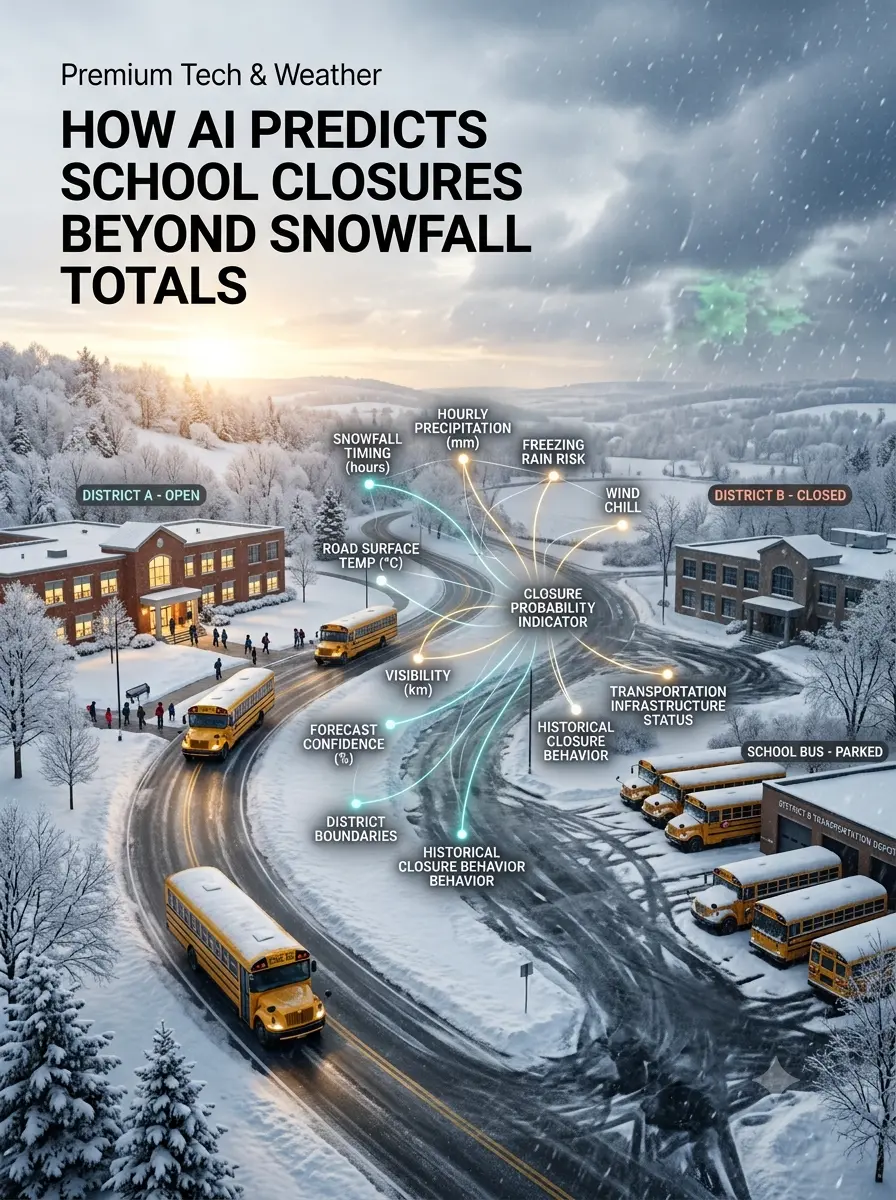
On January 18, 2025, a winter storm dropped roughly 5 inches of snow across the western Chicago suburbs between 4 AM and 10 AM. Naperville Community Unit School District 203 cancelled classes. Hinsdale Township High School District 86 — just 8 miles away — opened on time. Identical weather. Opposite decisions. Both calls were correct for their specific districts.
That scenario is exactly what a snow day calculator is built to navigate. It does not just ask how much snow is coming — it asks how your specific district has responded to storms like this one historically. The output is a probability score: a single number telling you whether tomorrow looks like a normal school day or a snow day, hours before your superintendent makes the official call.
This guide covers the full picture: the weather inputs, the district modeling, where predictions commonly fail, how to read your score by region, and when to check for best accuracy. If you want the number right now, the Snow Day Calculator is free. If you want to understand what the number means — keep reading.
How a Snow Day Calculator Actually Works
A snow day calculator is a prediction engine built for one task: estimating whether a specific school district will cancel or delay classes. Here is the full pipeline behind a prediction:
Step 1 — Live Weather Data Ingestion
The calculator pulls current National Weather Service NDFD gridded forecast data for your precise geographic coordinates — not just your city's nearest airport station. This includes hourly precipitation rate, accumulation, air temperature, dew point, wind speed, and precipitation type (snow, sleet, freezing rain). Data refreshes every 6–12 hours as new NWS model runs complete, which is why your score can shift substantially between an afternoon and an evening check. For the full data source list, see our Weather APIs page.
Step 2 — District Profile Matching
When you enter your ZIP code, the calculator maps it to every school district serving that location and loads that district's historical closure profile. This profile encodes multi-year closure and delay records, the district's effective closure threshold, infrastructure context (bus-heavy vs. walker-dominant, urban vs. rural road exposure), and the season-to-date closure count — which affects late-season decisions when emergency day budgets run thin.
Step 3 — Machine Learning Prediction
Current conditions are compared against historical scenarios where your district did and did not close. The model identifies patterns across thousands of past storm events: what combination of accumulation, timing, precipitation type, and road conditions historically produced closures for your specific district. The output is a probability score — not a point estimate, but a genuine reflection of how the current storm compares to past situations that produced closures. The NOAA National Centers for Environmental Prediction maintains the underlying forecast model data (GFS, NAM, HREF) that our predictions draw from.
Step 4 — Real-Time Adjustment Signals
Three additional signals update predictions dynamically:
- Cascade effect: When neighboring districts announce closures, smaller adjacent districts face logistical pressure to follow. Our model monitors regional announcements and adjusts scores upward when surrounding districts have already closed — because this historically raises closure probability for fence-sitting districts significantly.
- State DOT road condition feeds: Real-time road surface data (bare, partially covered, impassable) is integrated for most northern states when available. U.S. DOT road condition guidance informs how we weight surface temperature versus air temperature in ice risk calculations.
- Season fatigue factor: A district that has burned through most of its emergency day budget by late February may keep school open under conditions that would have triggered a November closure, to avoid mandatory year-end makeup days. This is weighted explicitly during late-season storms.
Why Simple Calculators Get It Wrong
Most snow day tools use a basic threshold formula: if 4 inches is forecast, score is 60%; if 6 inches, score is 80%. This sounds reasonable until you realize that accumulation thresholds alone explain less than half of actual closure decisions. Here is what separates a sophisticated tool from a shortcut:
- Applies a single regional cutoff (e.g. "4 inches = closure")
- Ignores storm timing entirely
- Treats all districts identically
- No ice or wind chill modeling
- No cascade or neighbor-district effects
- No season fatigue weighting
- Uses each district's historical closure behavior
- Weights hourly storm timing against the bus window
- Adjusts for infrastructure (bus routes, road tier)
- Models ice accumulation independently from snow
- Incorporates cascade pressure from neighboring districts
- Applies season fatigue for late-winter events
According to the American Meteorological Society, effective decision support tools must account for local infrastructure variability — not just raw meteorological inputs. A threshold model applied uniformly to Duluth, Minnesota and Raleigh, North Carolina will systematically underpredict closures in one and overpredict them in the other.
"The common mistake is treating snowfall totals as the primary closure trigger. In practice, a superintendent's decision depends equally on road surface conditions, timing relative to the bus run, and what adjacent districts are doing. None of those variables appear in a simple threshold table."
— Meteorological principle cited by the National Weather Association, reflecting professional forecasting practice standardsThe 7 Weather Factors That Drive School Closures
Not all winter weather carries equal weight in closure decisions. The factors below are ranked by their general importance in our model's feature weighting, drawing on NOAA's winter weather research and multi-year district closure data. Note that relative weights shift by district and storm type — these bars represent ordering, not fixed universal percentages.
| Factor | Relative Weight | Critical Threshold (varies by region) | Why It Matters |
|---|---|---|---|
| Snowfall timing | Peak between 5–9 AM | Heavy snow during the bus window is the single strongest closure trigger, regardless of total amount | |
| Total accumulation | 4–6 in. North; 1–3 in. South | Raw total matters, but timing determines how much of it road crews can address before buses run | |
| Wind chill | Below −15°F (NWS extreme cold threshold) | Extreme cold closes schools with zero snowfall — a factor many generic tools underweight. NWS cold safety guidance sets operational thresholds referenced by many districts. | |
| Ice / freezing rain | 0.1 in. accumulation | Ice triggers closures at far smaller amounts than snow — 0.25 in. of glaze can outweigh 6 in. of powder because ice cannot be plowed and is nearly impossible to treat once bonded to bridge decks | |
| Visibility | Below 0.25 miles | Blowing snow whiteout conditions can force closures even after roads are cleared — particularly relevant for rural districts with long bus routes across open terrain | |
| Road surface temperature | Below 28°F during precipitation | Snow on a 35°F road is slush. The same snow on a 26°F road is black ice. Surface temperature lags air temperature by 2–4 hours — a lag that matters enormously for overnight storm response. | |
| Forecast model confidence | Model agreement <70% | Low model agreement among GFS, NAM, and HREF widens the probability range on every other input — a high-uncertainty forecast produces a less reliable score regardless of what the numbers say |
Why Timing Beats Total Snowfall — Every Time
This is the most misunderstood aspect of snow day prediction, and the largest gap between a consumer weather app and a snow day calculator. Total snowfall is what gets announced on TV. Timing is what actually drives the closure decision.
Road crews — operating according to NWS Winter Storm Preparedness guidance — need roughly 3–4 hours to treat a full route network effectively. If snow stops before 3 AM, most northern districts can clear primary roads before the 6 AM bus run begins. If snow peaks between 6 and 9 AM, crews are chasing an ongoing storm during peak commute hours — a situation almost always resolved by closure.
| Scenario | Total Snow | Storm Window | Road Crew Response | Typical Outcome |
|---|---|---|---|---|
| A | 5 inches | 10 PM – 3 AM | 3+ hours before bus runs | ✅ School open — roads treated overnight |
| B | 5 inches | 4 AM – 8 AM | Minimal — peak during bus window | ⚠️ Delay or closure — crews can't keep up |
| C | 3 inches + freezing rain | 6 AM – 9 AM | None — roads icing during commute | ❌ Closure — ice + bus window = near-certain close |
| D | 8 inches | Noon – 6 PM | Full overnight recovery window | ✅ School open next day — overnight treatment possible |
Scenario C produces 3 inches closing schools while Scenario D's 8 inches does not. A raw weather app sees more snow in D and rates it as more dangerous. A snow day calculator sees the timing and correctly assigns C the higher closure probability. For the accumulation-by-state thresholds that inform these decisions, see our complete snow cancellation threshold guide.
The Gray Zone: Where 80% of Predictions Fail
Prediction errors cluster not at the extremes — a 95% score almost always produces a closure, and a 10% score almost always produces a normal school day. The failures concentrate in the 40–70% range: storms where the outcome genuinely could go either way, and where the model's confidence is lowest.
Three types of storms reliably produce gray-zone outcomes:
Forecast calls for 3 inches but a training band stalls and delivers 7 inches in the bus window. The model scored the storm at 45% based on the forecast; the actual closure was warranted. These errors originate in the underlying weather forecast, not the closure model — a hard limit on prediction accuracy that all tools share.
A district keeps school open under conditions that would close 80% of similar districts, because they pre-treated aggressively and have a high-capacity bus fleet. The model sees the weather and scores 65%; the district opens. These errors are reduced when district calibration data is deep but never eliminated.
A superintendent closes school at 45% conditions because it is the last emergency day before makeup days kick in, or because a board meeting creates scheduling pressure, or because community pressure follows an accident the previous week. No model can predict this. Probability never reaches certainty because human decisions are never mechanical.
Understanding the gray zone matters for how you use the score. In the 40–70% range, the appropriate action is not "plan for school" or "plan for snow day" — it is to build contingency plans for both and recheck at 10 PM when the model has fresh data. For guidance on building a smart monitoring routine, see our snow day calculator for tomorrow guide.
How to Read Your Probability Score by Region
A probability score means something different depending on where you live — for a deeper explanation of what the number actually measures, see our guide on what your probability score actually means. Two of the most common user errors are applying northern thresholds to southern districts, or treating the score as binary (closed/open) rather than probabilistic. Two of the most common user errors are applying northern thresholds to southern districts, or treating the score as binary (closed/open) rather than probabilistic. As the National Weather Service's winter safety guidance notes, hazard impact varies dramatically by region — a half-inch of snow has the same operational significance in Atlanta as 4 inches in Minneapolis.
| Score | Northern Districts (MN, MI, NY, PA, OH) | Southern Districts (NC, GA, TN, TX, VA) | Recommended Action |
|---|---|---|---|
| 0–25% | Almost certainly open | Almost certainly open | Plan a normal day |
| 26–45% | Likely open; delay possible | Increasingly uncertain — southern thresholds activate earlier | Monitor; sketch a backup plan |
| 46–65% | Coin-flip; 2-hour delay most common outcome | Closure likely — most southern districts close before 70% | Arrange tentative childcare; recheck at 10 PM |
| 66–80% | Closure or delay in most cases; infrastructure is the deciding factor | Near-certain closure | Confirm childcare; notify employer |
| 81–92% | Closed in most cases; some districts may delay instead | Closed in almost all cases | Treat as a snow day; finalize arrangements |
| 93–100% | Full closure; possible multi-day event | Full closure; possible state emergency declaration | Plan for extended closure |
The confidence rating matters as much as the probability number. A 75% prediction with high model agreement is far more reliable than 75% with low confidence — the latter means the weather forecast itself is uncertain, which adds error on top of the inherent variability in district decision-making. In low-confidence situations, treat the score as a wider range, not a point estimate.
Why District Calibration Is the Biggest Differentiator
The Chicago-area opening example is not an anomaly — it is the rule. District-level behavioral variation is the norm in winter weather responses, and it is the primary reason generic regional tools underperform district-specific ones.
Naperville D203 vs. Hinsdale D86: Same Storm, Opposite Decisions
A January 18, 2025 storm delivered approximately 5 inches of snow across the western Chicago suburbs between 4 AM and 10 AM. Naperville Community Unit School District 203 cancelled classes. Hinsdale Township High School District 86 — 8 miles away — opened on time.
The difference came down to transportation infrastructure: Naperville operates a large bus network serving students across lower-density, secondary-road neighborhoods. Hinsdale has a more compact geography with a higher percentage of walkers and a road grid that gets plowed earlier. Both decisions were correct for their respective districts' actual operating realities — which is precisely why a single regional threshold model would have gotten one of them wrong.
Factors driving district-to-district variation:
- Bus dependency: Districts where most students ride buses — particularly on secondary and rural roads — close more readily than pedestrian-dominant or compact urban districts. The Safe Roads Now school bus safety guidance documents how road condition standards for buses differ from those for personal vehicles.
- Road priority tier: Districts on major state routes get plowed earlier than those served primarily by county or township roads, giving crews more response time before buses run.
- Pre-treatment budget: Districts that brine roads ahead of storms require fewer inches of accumulation to stay open safely. Budget-constrained districts are more vulnerable to moderate storms.
- Superintendent decision history: A district that kept schools open during a storm that caused accidents will close more conservatively afterward — a behavioral shift our model captures from historical closure data.
- Cascade pressure: When large adjacent districts close first, fence-sitting districts face logistical pressure from families with children in multiple districts. This peer effect is modeled explicitly.
This is why ZIP code entry — not city or county selection — produces the most accurate predictions. For a direct comparison of how different tools handle district calibration, see our most accurate snow day calculator comparison.
Regional Deep Dive: Alberta vs. Texas vs. Michigan
Closure behavior is not just a north-south gradient. It reflects the entire operational context of a school system: climate acclimation, equipment, staffing, bus infrastructure, and the historical baseline for what counts as "bad" weather. Three regions illustrate this range clearly.
Alberta school districts routinely operate in conditions that would close schools in most U.S. states. Buses are diesel-heated and tested to operate in deep cold. The effective closure threshold for accumulation alone is well above 12 inches in most districts. The dominant closure trigger is extreme cold — not snow — with most districts establishing wind chill thresholds around −40°C (−40°F) for school cancellation. Our model uses province-specific behavioral data because a Canadian threshold applied to a Texas district, or vice versa, produces completely wrong predictions. For full details, see our Canada snow day calculator guide and Ontario-specific calculator.
Texas's 2021 winter storm (Winter Storm Uri) exposed what meteorologists and infrastructure specialists had long documented: a grid and road system unbuilt for sustained winter conditions. But even in normal winters, Texas districts close for conditions that seem trivial from a Minnesota perspective. The reason is infrastructure: roads in central and south Texas are rarely pre-treated, road crews have minimal equipment, and school buses are not equipped for sustained cold or ice. A single ice event of 0.2 inches is sufficient for many central Texas districts to close. A 35% probability score in Austin carries the same practical meaning as a 70% score in Buffalo. Our model applies Texas-specific behavioral calibration automatically when you enter a Texas ZIP code — which is why generic tools systematically underpredict Texas closures.
Michigan presents the most internally variable closure behavior of any state in our dataset. The Upper Peninsula, accustomed to 200+ inches of lake-effect snow per season, closes school far less readily than similar accumulation events would produce in, say, Wayne County. Traverse City (northwestern Lower Peninsula) experiences heavy lake-effect events and has developed the infrastructure to match. Suburban Detroit districts behave more like Ohio or Indiana — moderate thresholds, strong pre-treatment programs. A single "Michigan threshold" is meaningless; district-level calibration is the only way to get reliable predictions across the state's enormous variation.
Overnight snowfall that clears before 5 AM gives road crews time to respond before bus runs begin. The same accumulation arriving at 7 AM — peak bus window — produces a very different closure outcome. Timing is the decisive variable.
When to Check for Maximum Accuracy
Forecast accuracy improves as you approach the event. But the relationship between check-time and usefulness has a practical ceiling: most districts make the official call between 4:30 and 5:30 AM. Time your checks accordingly.
Evening NWS model runs are complete. Overnight accumulation is well-characterized. You still have time to arrange childcare. This is the highest-value check of the cycle — act on what you see here.
Can catch last-minute track changes. However, many districts announce between 4:30–5:30 AM — you may be confirming what was already decided rather than getting ahead of it.
You are reading stale morning model data. Evening runs have not yet completed. Predictions at this hour can change materially — sometimes 15–20 points — by 10 PM.
At 72+ hours, storm tracks carry real uncertainty. A storm forecast for 8 inches Thursday can track 60 miles north by Wednesday and miss entirely. Watch — do not plan on it.
Snow Days vs. Virtual Days: What the Calculator Shows
Since 2020, the meaning of "school closed" has changed in a growing number of states. Many districts now have state authorization to use pre-approved virtual learning days in place of traditional cancellations — which means a high closure probability might mean remote school rather than a day off. This distinction is consequential and most snow day tools ignore it entirely.
States that have authorized virtual or e-learning snow days include Ohio (up to 5 per year), Indiana (4 per year), Michigan (6 per year), and Texas (unlimited with an approved plan), among others. New York and Pennsylvania still require traditional makeup days for most closures. Virginia and Georgia have limited pilot or emergency-use authorizations only.
Our tool flags virtual day authorization status for districts where it is known, so you understand whether a predicted closure likely means a true day off or a structured remote school day. For the full state-by-state breakdown. For how college and university closures differ from K–12 decisions, see our college campus closure guide.
5 Mistakes People Make Reading Predictions
Focusing Only on Total Snowfall
The forecast says 7 inches — school will definitely close, right? Not necessarily. Seven inches falling from 10 PM to 4 AM with clearing by sunrise often means school opens normally, because roads can be treated overnight. The same 7 inches falling from 6–10 AM almost always closes schools. Total matters far less than timing — a fact that NWS winter weather guidance emphasizes in its operational decision-support resources.
Fix: check the storm's hourly timeline, not just the totalIgnoring the Forecast Confidence Signal
A 70% probability with low model confidence is not the same as 70% with high confidence. Low confidence means the GFS, NAM, and HREF models are diverging on storm track or intensity — which adds uncertainty on top of the inherent variability in district decisions. In low-confidence situations, treat the score as a range spanning ±15 points, not a reliable single number.
Fix: treat low-confidence scores as wider probability rangesComparing Scores Across Districts
"The calculator says 65% for us but my friend's district nearby has 45% — someone's wrong." Not necessarily. Different districts have genuinely different closure thresholds. Your district may close more readily because of rural bus routes, an older fleet, or a more cautious superintendent. Identical weather legitimately produces different probabilities for different districts — the scores are designed to reflect each district's individual baseline, not a common standard.
Fix: interpret scores relative to your district's behavior, not neighbors'Checking in the Afternoon and Trusting That Score
A 3 PM check shows you morning model data that has not updated with the day's observations. The 10 PM prediction for the same storm can differ by 15–20 percentage points if the storm has shifted or intensified since the morning run. An afternoon score is an early indicator — use it to watch, not to plan around definitively.
Fix: use the 10–11 PM check as your planning score, not the afternoon oneTreating the Prediction as a Guarantee
A high probability means schools closed under similar historical conditions most of the time — and stayed open some of the time. Every superintendent makes the final call based on factors no model can know: makeup days remaining, state assessment schedules, a 4 AM bus test drive that found roads better than forecast, or a community political dynamic. Probability is not certainty. Plan for the most likely outcome while keeping a contingency ready.
Fix: use the score to calibrate plans, not to make irrevocable commitments📋 Model Transparency & Accuracy Disclosure
This guide does not publish fixed accuracy percentages because accuracy varies materially by district, storm type, season, and lead time. Claiming a single number would be false precision that misleads users into over-relying on the tool. What we can document: accuracy is substantially higher at 6-hour lead times than at 72-hour lead times, and higher for southern districts (lower, more consistent thresholds) than for northern districts operating in a wider gray zone.
Our closure data is sourced from official district announcement records. Our weather data comes from NWS NDFD gridded forecasts and NCEP model outputs. For full methodology details, see our Data Sources page and References.
Will Your School Close Tomorrow?
Enter your ZIP code for an AI-powered school closure probability calibrated to your district's specific closure history — updated with the latest NWS forecast data every time you load the page.
❄️ Check Your Snow Day ProbabilityFrequently Asked Questions
How does a snow day calculator work?
A snow day calculator pulls live NWS NDFD gridded forecast data for your exact coordinates and runs it through a model trained on years of actual closure decisions in your specific district. It identifies how your district has historically responded to similar combinations of accumulation, timing, ice, and wind chill — and outputs a probability score. The key distinction from a weather app: it models what your district will likely do about the weather, not just what the weather will be.
Are snow day calculators accurate?
Accuracy improves significantly as you get closer to the event. At 72 hours, storm tracks are still shifting and predictions carry wide uncertainty. By 10–11 PM the evening before, accuracy is substantially higher. By 5–6 AM the morning of, with overnight conditions known, it reaches its peak. We do not publish a fixed accuracy percentage because it varies materially by district and storm type. See our Data Sources documentation for methodology details.
What probability score means school will likely close?
Above 70% indicates a high likelihood for most northern districts — but the threshold shifts substantially by region. A 55% score in Atlanta or Charlotte may carry more practical certainty than 70% in Buffalo or Minneapolis, because southern districts have significantly lower closure thresholds. The calculator adjusts for your local baseline automatically; the score already reflects your district's historical behavior.
When should I check a snow day calculator?
10–11 PM the night before is the highest-value check. Evening NCEP model runs are complete, overnight accumulation is well-characterized, and you still have time to arrange childcare. Avoid the afternoon (3–7 PM) — you're reading stale morning model data. For full timing guidance, see our snow day calculator for tomorrow article.
Can a snow day calculator predict delays versus full closures?
Yes. The tool outputs three separate probability estimates: full-day cancellation, 2-hour delayed start, and normal operations. The distinction matters practically — two hours of childcare versus a full day are very different logistical problems. Storm timing is the key: snow ending by 6–7 AM with improving conditions points toward a delay; snow peaking between 6–9 AM points toward full closure.
Why do two neighboring districts get different scores for the same storm?
Because closure behavior is shaped by infrastructure, not just geography. The Naperville/Hinsdale example from January 2025 illustrates this precisely. Bus dependency, road priority, pre-treatment budget, and superintendent decision history all vary district-by-district. Identical weather legitimately produces different closure probabilities for different districts.
Do snow day calculators work for ice storms and extreme cold?
Yes. Ice accumulation and wind chill are modeled as separate inputs. Ice is often more disruptive than snow — 0.25 inches of glaze can outweigh 6 inches of powder because ice is nearly impossible to treat once it forms on bridge decks and overpasses. According to NWS winter safety guidelines, freezing rain events are among the most dangerous winter hazard types for transportation — a finding our model incorporates through elevated ice weighting.
How is this tool different from AccuWeather or a weather app?
Weather apps tell you what conditions will be. A snow day calculator tells you what your district will likely do about those conditions. Most tools apply a generic regional formula: if X inches is forecast, score is Y%. Our tool models each district's individual historical behavior, incorporates cascade effects from neighboring districts, applies season fatigue weighting, and integrates real-time state DOT road data where available. For direct comparisons, see our AccuWeather vs. AI comparison, and our guide to the most accurate snow day calculators.
Does the calculator work for Canadian districts?
We have extended our model to major Canadian districts with province-specific behavioral data. See our Canada snow day calculator guide and Ontario-specific calculator.
What is the most common mistake people make when reading predictions?
Focusing on total snowfall rather than storm timing. A 7-inch overnight event that clears by 4 AM is manageable for road crews; the same 7 inches falling from 6–10 AM is not. The number that drives closure decisions is not how much snow falls — it is when.
Sources & References
Authoritative Sources Referenced in This Guide
- National Weather Service — Winter Weather Safety NWS operational guidance on winter hazard thresholds; basis for closure trigger discussion
- NOAA — Winter Weather Education Resources NOAA research on regional weather factor variation; cited in 7 weather factors section
- NOAA National Centers for Environmental Prediction (NCEP) Source of GFS, NAM, and HREF model data used in all predictions
- NWS National Digital Forecast Database (NDFD) Gridded forecast data feed used for coordinate-level weather inputs
- NWS — Winter Storm Preparedness and Response Guidance (PDF) Operational decision-support guidance referenced in storm timing analysis
- National Weather Service — Extreme Cold Safety Wind chill threshold standards referenced in extreme cold closure discussion
- National Center for Atmospheric Research (NCAR) Weather prediction research and forecast model accuracy studies
- American Meteorological Society (AMS) Meteorological terminology, forecasting standards, and decision-support tool best practices
- National Weather Association (NWA) Professional forecasting standards; quoted in simple calculators comparison section
- U.S. Department of Transportation — Winter Weather Safety Road condition standards for transportation operations; cited in bus route discussion
- Safe Roads Now — School Bus Safety in Winter Conditions Bus safety standards and road condition requirements; cited in district calibration section
- Weather Underground — Data Sources Documentation Comparison of forecast data source types referenced in methodology overview