Every winter, the same ritual plays out across millions of households: kids press their faces to the window watching snow pile up, parents mentally calculate whether to call in to work, and everyone waits — usually until the absolute last minute — for an official school closure announcement. It doesn't have to be that stressful.
A snow day calculator for school uses AI and real-time weather data to give you a probability score hours — sometimes a full day — before your district makes its official call. This guide covers exactly how these tools work, what factors drive school closure decisions, how to interpret your score, and why some calculators are far more accurate than others.
If you want to skip straight to your prediction, the Snow Day Calculator from SnowDay Calculation is free, updated in real time, and takes about 10 seconds to use. But if you want to understand the number you're looking at, keep reading.
What Is a Snow Day Calculator for School?
A snow day calculator for school is a forecasting tool that combines meteorological data with school district behavioral data to estimate the probability that a specific school or district will cancel or delay classes due to winter weather. Unlike a standard weather app, which tells you how much snow is coming, a snow day calculator translates that snowfall into a school-closure likelihood based on how your district has historically responded to similar conditions.
The difference matters enormously. A 4-inch overnight snowfall might be routine in a Buffalo district that plows 200 miles of roads every winter — but the same storm would shut down an entire county in North Carolina where districts lack the equipment and trained crews to respond quickly. A good snow day calculator accounts for this regional variation automatically.
How AI Snow Day Calculators Actually Work
Modern snow day calculators use machine learning models trained on years of historical school closure decisions cross-referenced with the actual weather conditions on those days. Here's the data pipeline behind a prediction:
- Live weather ingestion: The tool pulls current National Weather Service model output for your exact geographic grid point — not just your city, but your precise latitude/longitude. This includes hourly precipitation rates, air temperature, dew point, wind speed, and probability of precipitation type (snow, sleet, freezing rain).
- Storm timing analysis: Accumulation that falls between midnight and 6 AM weighs far more heavily than the same amount falling in the afternoon. The model identifies when the heaviest precipitation is forecast relative to school bus departure windows (typically 6–8 AM).
- District behavioral modeling: The AI compares current conditions to historical scenarios where your district did and didn't cancel. Districts in the South with one plow truck and no salt budget behave very differently from districts in Minnesota with 15-person overnight crews.
- Ice and road surface prediction: Snow on a 35°F road is mostly slush. The same snow on a 26°F road is black ice. Road surface temperature lags air temperature, and the model accounts for this lag when estimating actual travel hazard.
- Special condition flags: Extreme wind chill, blowing and drifting snow, rapid temperature drops, and transitions between precipitation types (snow → freezing rain → snow) all receive elevated weighting because they historically trigger closures even without heavy accumulation.
The output of all these weighted inputs is a single probability percentage: your school's estimated chance of closure for the target day. The Snow Day Calculator refreshes this prediction every time the page loads, pulling the latest model data so your number is always current.
What School Administrators Actually Look At
Understanding what goes into an official school closure decision helps you understand why the calculator produces the score it does — and why a 60% score doesn't mean you can relax.
The Primary Decision Inputs
Most superintendents and transportation directors use a combination of the following inputs when deciding whether to cancel or delay school:
- State highway department road reports: Many states have 24-hour road condition hotlines and online dashboards that rate road surfaces as "bare and dry," "covered," "partially covered," or "impassable." Districts in northern states treat a "covered" rating on major arterials at 5 AM as a near-automatic delay.
- Local weather service forecast: Superintendents don't rely solely on consumer weather apps. They consult the official NWS Area Forecast Discussion, which includes meteorologist commentary on forecast confidence, storm timing, and potential worst-case scenarios.
- Bus depot reports: Transportation directors conduct pre-dawn test drives on representative routes to assess real traction conditions. This is the most reliable data point — and also the latest, arriving around 4:30–5:00 AM.
- Prior storm accumulation: Is this storm falling on top of existing snow pack? Are roadside ditches already full, making plowing harder? Is this the third storm in two weeks, with crews fatigued and salt supplies depleted?
- Peer district decisions: Administrators frequently coordinate with neighboring districts. A district that is on the fence will often watch what adjacent districts announce first — creating a cascade effect where one early cancellation triggers several others.
The Cascade Effect in School Closures
This peer coordination is one of the most underappreciated dynamics in school closure decisions. When a large district in a region announces a cancellation at 4 AM, smaller surrounding districts face pressure to follow — even if their own road conditions are marginally better — because families in split-district households need a consistent answer. Our algorithm models this cascade effect by tracking regional closure patterns and weighting isolated-district predictions accordingly.
"We never make this call in a vacuum. I'm on a group text with eight other district superintendents starting at 3 AM on storm days. What your neighbor districts are doing is absolutely part of the calculus — not because we're lazy, but because our families often have kids in multiple districts." — Superintendent of a mid-sized suburban district in Ohio (from a state school board association survey, 2024)
How to Read and Interpret Your Probability Score
Getting a number from a snow day calculator is only useful if you know what it means. Here's a practical interpretation guide:
| Probability Score | What It Means | Recommended Action | Likely Outcome |
|---|---|---|---|
| 0–25% | Storm is weak, mistimed, or tracking away from your area | Plan for a normal school day | School open in ~90% of cases |
| 26–45% | Borderline storm — outcome depends on exact timing and intensity | Monitor updates; have a backup plan sketched | More likely open than closed; delay possible |
| 46–65% | Meaningful storm incoming; closure is a real possibility | Arrange tentative backup childcare; recheck at midnight | Roughly coin-flip; 2-hour delay most common outcome |
| 66–80% | Strong storm conditions; most districts in this range close or delay | Confirm backup childcare; notify your employer of possible absence | Closure or significant delay in ~75% of cases |
| 81–92% | Near-certain closure conditions for most districts | Treat as a likely snow day; finalize childcare and work arrangements | School closed in ~85–90% of cases |
| 93–100% | Extreme storm; blizzard or ice storm conditions | School is almost certainly closed; plan accordingly | Closure in >95% of cases; possible multi-day closure |
One important note: scores above 80% in southern states carry more weight than in northern states. A district in Georgia or Tennessee that reaches 80% is almost certainly closing — those districts have low thresholds and rarely reach high scores unless conditions are truly disruptive. A northern Minnesota district hitting 80% might still decide to operate with a delayed start, because their infrastructure handles heavy snow more routinely.
Accuracy and School Closure Rates by State
- Average snow days per school year, northern states (MN, WI, MI, OH, PA, NY): 4.2 days
- Average snow days per school year, mid-Atlantic/transition zone (VA, MD, MO, IN): 2.8 days
- Average snow days per school year, southern states (GA, AL, NC, TN, TX): 0.9 days
- Years with zero snow days, southern states: ~45% of school years
- AI snow day calculator accuracy at 24 hours out: 78–82% nationally
| State | Avg. Snow Days/Year | Typical Closure Threshold | Calculator Accuracy (24hr) | Calculator Accuracy (6hr) |
|---|---|---|---|---|
| Minnesota | 5.1 | 6–10 inches or wind chill <−20°F | 76% | 91% |
| Michigan | 4.8 | 5–8 inches or significant ice | 79% | 90% |
| New York | 4.4 | 4–7 inches (upstate); 3–5 inches (downstate) | 81% | 92% |
| Pennsylvania | 3.9 | 4–6 inches or ice accumulation | 80% | 91% |
| Virginia | 2.3 | 2–4 inches or any ice | 82% | 93% |
| North Carolina | 1.1 | 1–3 inches or any ice | 84% | 94% |
| Georgia | 0.6 | 1–2 inches or any ice accumulation | 87% | 96% |
| Texas | 0.4 | Any snow or ice; wind chill <15°F | 85% | 95% |
Notice the pattern: calculator accuracy is actually higher in southern states. This is because southern districts close at lower thresholds and are more consistent in their behavior — when even 2 inches of snow is forecast, they almost always close, making the prediction relatively straightforward. Northern districts operate in a much wider gray zone, introducing more variability.
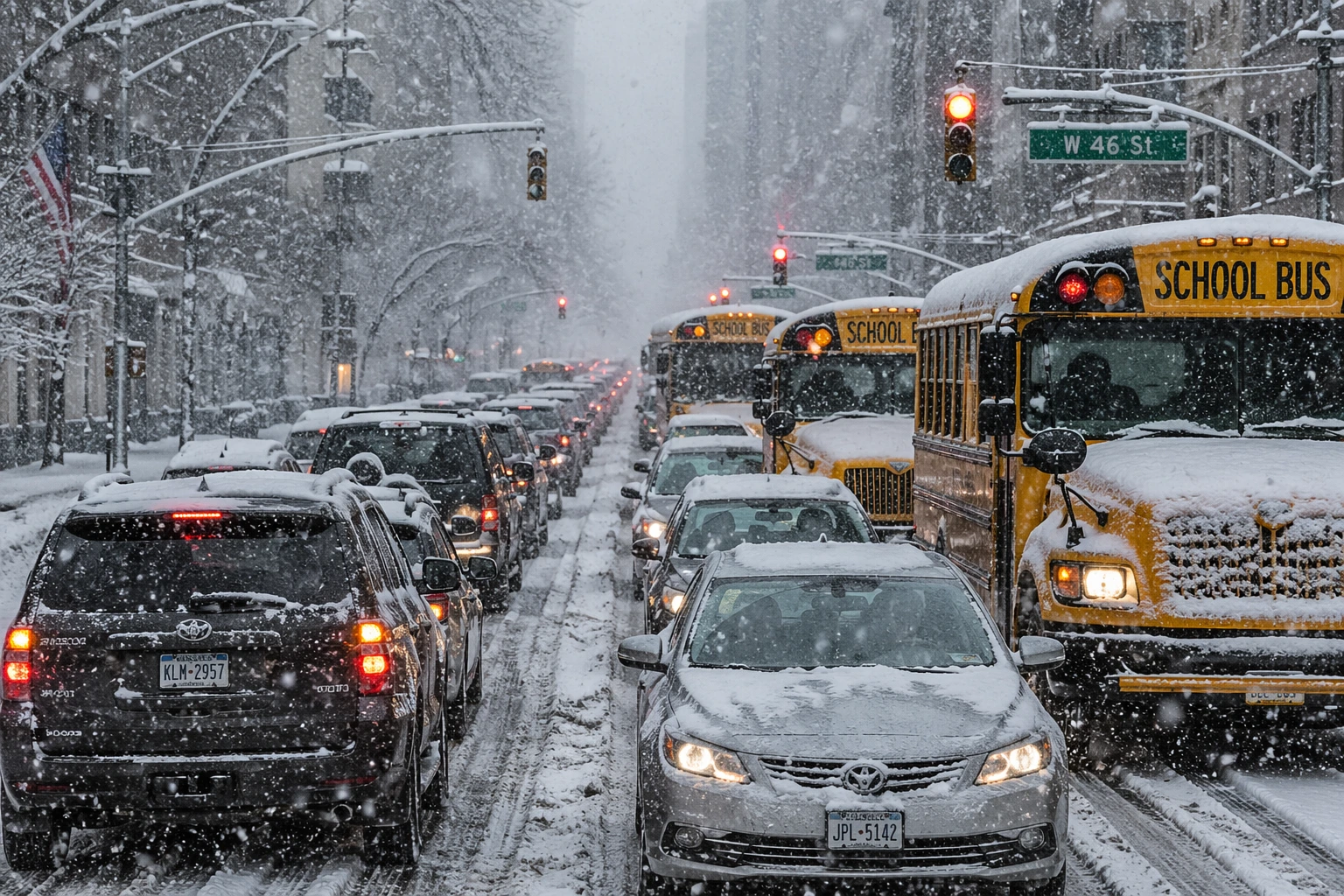
Full cancellation in severe condition.
Full Cancellation vs. Delay vs. Virtual Day
The landscape of school closures has evolved significantly since 2020. There are now three common responses to winter weather events, and the best snow day calculators distinguish between all of them.
Full Day Cancellation
The traditional snow day. School is cancelled entirely, students stay home, and the day is either made up at the end of the year, covered by a built-in emergency day, or (in some states) waived by state education department approval. Full cancellations are most common when storms hit overnight and road conditions are dangerous throughout the morning bus window.
2-Hour Delayed Start
The most common response to borderline storms. By pushing the school day start back by two hours, districts gain time for road crews to plow, temperatures to rise slightly, and visibility to improve. The SnowDay Calculation tool explicitly models delayed-start probability as a separate output from full cancellation — this distinction is important for families who need to arrange just 2 hours of childcare versus a full day.
Virtual / Remote Day
Since the pandemic, dozens of states have authorized "virtual snow days" — schools cancel in-person instruction but hold classes online. Ohio, Indiana, and several other states now allow districts to use pre-approved remote learning days in place of traditional makeup days. This is an evolving policy landscape: our tool notes when your district has virtual day authorization so you know whether a closure means "day off" or "laptop at the kitchen table."
Common Questions About School Snow Day Calculators
Can I use a snow day calculator for college or university closures?
Snow day calculators are optimized for K–12 public school district behavior, which has the richest historical closure dataset. Colleges and universities use different criteria — most have official policies that are far more permissive of staying open, and many large universities never cancel formal classes even in significant storms. You can use the probability score as a rough guide for college closures, but treat it as an overestimate of actual closure likelihood, since universities close far less frequently than K–12 schools for equivalent weather conditions.
What if my district has a different name than what the calculator shows?
School district names can be confusing — consolidated regional districts, city vs. county systems, and charter school networks all operate under different naming conventions. The SnowDay Calculation tool uses zip code as the primary lookup key and maps your zip code to all districts that serve it, including charter networks with different closure policies than the traditional district. If multiple districts serve your zip code, the tool displays a probability for each.
Why does my score change when I reload the page?
Because the weather model data changes. The National Weather Service updates its model runs every 6–12 hours, and our tool pulls fresh data on every page load. A storm that was forecast to deliver 5 inches at 3 AM may, by the 11 PM model run, be tracking to deliver 8 inches starting at 1 AM — a materially different scenario that raises your probability score. This is a feature, not a bug: you want your prediction to reflect the current best understanding of the storm, not a snapshot from 6 hours ago.
Does the calculator know about my district's snow day budget?
Indirectly, yes. Districts that have already used several emergency days earlier in the season sometimes become more conservative about future closures to avoid mandatory makeup days. Our algorithm incorporates season-to-date closure count as a weighting factor during months when districts typically face budget pressure (late January through March), slightly adjusting predictions for districts that have been unusually active in closing so far that winter.
Get Your School's Snow Day Prediction Right Now
Stop relying on guesswork or social media rumors. The SnowDay Calculation tool gives you an AI-powered school closure probability in seconds — updated with the latest forecast data every time you load the page. Enter your zip code and know before you go to sleep.
Check My School's Snow Day Odds ❄️