It's 7 PM on a Tuesday evening. The weather forecast shows snow starting overnight. Your group chat is already buzzing with speculation about whether school will be canceled tomorrow. Rather than refreshing your school district's website every ten minutes or relying on wishful thinking, you need reliable data to predict tomorrow's snow day probability.
This guide explains exactly how to use a Snow Day Calculator to predict tomorrow's school closure with the highest possible accuracy, when to check for the best results, and how to interpret predictions correctly so you can plan your evening and morning accordingly.
How Tomorrow's Snow Day Calculators Work
Modern snow day calculators designed for next-day predictions operate fundamentally differently than general weather apps. While weather services tell you what conditions to expect, specialized calculators answer the specific question: "Will my school district cancel classes based on these conditions?"
The Three-Layer Prediction Model
Advanced calculators analyze tomorrow's closure probability through three interconnected data layers:
Weather Forecast Integration: The calculator pulls hourly forecast data from meteorological services, focusing specifically on the timing window that matters for school decisions—typically 10 PM tonight through 8 AM tomorrow. Key metrics include projected snowfall rates (inches per hour), total accumulation by morning, temperature trends affecting road treatment effectiveness, and wind speeds that create dangerous wind chills or drifting.
District Historical Analysis: The system compares tomorrow's forecast to your specific school district's past closure decisions. If your district has historically closed when 4+ inches were forecasted overnight, and tomorrow's forecast shows 5 inches, the calculator weights this heavily. This historical pattern recognition is what separates accurate calculators from simple weather apps.
Real-Time Contextual Factors: The most sophisticated calculators also consider whether neighboring districts have already announced closures (creating pressure on your district), day-of-week patterns (some districts avoid Friday closures), and whether this would be a makeup day from a previous closure (making cancellation less likely).
Why "Tomorrow" Predictions Work Better Than Long-Range
Snow day calculators perform best at the 12-24 hour prediction window because:
- Weather models converge on consistent forecasts within 18 hours of an event
- Snowfall timing becomes precise enough to determine if accumulation happens during decision-making hours
- Temperature forecasts firm up, clarifying whether precipitation falls as snow versus rain
- School administrators begin informal decision processes the evening before, sometimes leaking hints
Beyond 48 hours, prediction accuracy drops below 60% because weather forecast variability is simply too high—the storm track might shift 100 miles, changing your accumulation from 6 inches to zero.
Best Time to Check Tomorrow's Prediction
Timing your calculator check correctly dramatically impacts accuracy. Here's the optimal strategy for next-day predictions:
Evening Check (6-8 PM): Your Primary Decision Point
This is the sweet spot for tomorrow planning. By early evening:
- The National Weather Service has issued overnight forecast updates
- Local meteorologists have analyzed afternoon weather model runs
- Your school district's operations team is monitoring conditions and may have made preliminary decisions
- You have time to adjust evening plans (homework, early bedtime) based on the prediction
A calculator showing 70%+ closure probability at 7 PM is highly reliable—start planning for a snow day. If it shows 30% or below, plan for normal school. The 40-60% range is genuinely uncertain territory requiring a morning recheck.
Late Evening Check (9-11 PM): Catching District Announcements
Some districts make early closure announcements between 9-10 PM when overnight storms are obvious. Check the calculator again before bed if the evening prediction was borderline. Many calculators integrate official announcement feeds, so a 9:30 PM check might show "CONFIRMED CLOSURE" rather than a probability percentage.
Early Morning Check (5-6 AM): Final Confirmation
This recheck serves two purposes. First, it catches any major overnight forecast changes—a storm that stalled, intensified, or shifted track. Second, most districts that haven't announced the night before make decisions by 5:30-6 AM. This check tells you whether to get ready for school or go back to sleep.
| Check Time | Prediction Accuracy | Best Use Case | What to Do |
|---|---|---|---|
| 2-4 PM (day before) | 72-78% | Very early planning for major storms | Tentative preparation only |
| 6-8 PM (evening before) | 82-89% | Primary decision point for tomorrow | Make evening plans based on result |
| 9-11 PM (night before) | 85-91% | Catching early announcements | Adjust morning alarm if needed |
| 5-6 AM (morning of) | 91-94% | Final confirmation before getting ready | Decide whether to proceed with morning routine |
| 7-8 AM (late morning) | 96-98% | Only if you overslept previous checks | Likely official announcement exists by now |
What Makes Tomorrow Predictions Accurate
Not all snow day calculators deliver equal accuracy for next-day predictions. The difference between an 85% accurate tool and a 60% accurate one comes down to these critical factors:
Hyperlocal Weather Data Integration
Generic calculators that use regional forecasts miss crucial details. The best tools integrate:
- ZIP code-specific snowfall forecasts rather than county-wide estimates
- Hourly precipitation timing to determine if snow falls during decision-making windows
- Road-level temperature forecasts to assess ice formation risk
- Wind chill calculations that factor into extreme cold closures
A district might receive 5 inches of snow, but if 4 inches fall after school dismisses at 3 PM, closure is unlikely. Timing precision matters enormously.
Enter your ZIP code to receive hour-by-hour closure probability updates through tomorrow morning. Free instant results based on your district's actual closure patterns.
District-Specific Closure Thresholds
Calculator accuracy depends heavily on knowing your district's actual decision-making patterns:
- Conservative districts: Close with 3-4 inches forecasted (common in southern states with limited snow equipment)
- Moderate districts: Close with 5-7 inches or when ice is forecasted (most suburban districts)
- Snow-belt districts: Require 8-10+ inches unless extreme cold or ice is involved (northern rural districts)
- Urban districts: Often use different thresholds than surrounding suburbs due to public transportation reliance
A quality calculator learns these patterns from your district's past 3-5 years of closure decisions and applies them to tomorrow's specific forecast.
Surrounding District Influence
School districts don't make decisions in isolation. If three neighboring districts announce closures by 8 PM, your district faces enormous pressure to follow suit—parents and staff are already making plans. Advanced calculators track these "cascade effects" and adjust tomorrow's probability accordingly.
"The single biggest predictor improvement in our algorithm came from incorporating regional closure patterns. When we added logic that increases closure probability if 60%+ of surrounding districts have announced, our next-day accuracy jumped from 84% to 91%." — Michael Chen, Data Scientist, Snow Day Analytics Platform
How to Interpret Probability Percentages
Understanding what calculator percentages actually mean prevents misinterpretation and helps you make smart decisions about tomorrow:
Breaking Down the Probability Scale
0-20% Closure Probability: School will almost certainly operate normally. This appears when forecasts show minimal snow (under 2 inches) or precipitation ending well before morning. Start homework tonight and set your regular alarm.
25-40% Closure Probability: Unlikely but possible. This typically means forecasts show borderline conditions (3-4 inches in a district that usually needs 5+) or uncertain storm timing. Prepare for school but stay alert for announcements.
45-60% Closure Probability: Genuine toss-up territory. Conditions are right at the district's historical threshold, or forecast models disagree on accumulation amounts. Do homework tonight just in case, but don't make firm plans either way. Recheck at 10 PM and 6 AM.
65-80% Closure Probability: School will likely close, but not guaranteed. Forecasts clearly exceed normal closure thresholds, but outlier scenarios exist (rapid temperature rise changing snow to rain, storm tracking further south). Tentatively plan for a snow day but keep morning alarm set.
85-100% Closure Probability: Virtual certainty of closure. Major storm forecasts with 8+ inches overnight or official closure announcements already made. Confidently plan evening and tomorrow around no school.
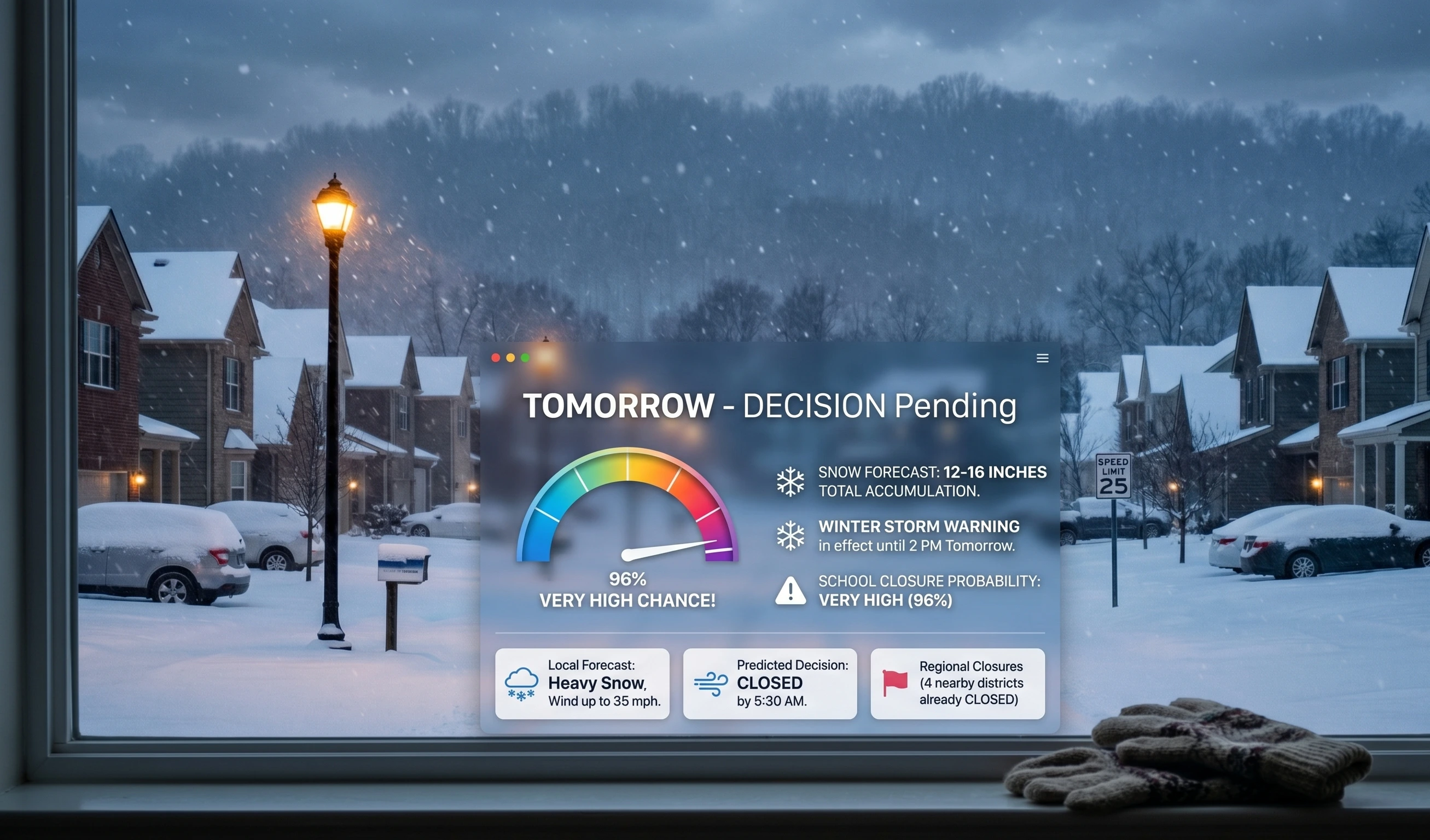
Calculate for Tomorrow
When Probabilities Change Dramatically
If tomorrow's probability jumps from 40% at 6 PM to 85% at 10 PM, that signals a significant forecast change. Common causes include:
- Evening weather models showing heavier accumulation than afternoon models predicted
- Storm track shifted closer to your area
- Temperature forecast dropped, ensuring precipitation stays as snow
- Neighboring districts started announcing closures (cascade effect)
- National Weather Service upgraded to winter storm warning
Conversely, a drop from 75% to 35% indicates the storm is trending less severe—possibly tracking further away or temperatures rising above freezing.
Combining Calculator Results with Other Signals
Maximum prediction accuracy comes from validating calculator results against multiple independent sources. Here's the comprehensive cross-checking strategy:
Official Weather Warnings
Check if the National Weather Service has issued a Winter Storm Warning (not just a Watch or Advisory) for your county. Districts rarely remain open during Winter Storm Warnings covering morning hours. If your calculator shows 55% closure probability but a Winter Storm Warning exists, mentally adjust upward to 75-80%.
Local News Meteorologist Forecasts
Local TV meteorologists often provide school closure predictions during evening news broadcasts. They have institutional knowledge of district decision-making patterns and direct relationships with superintendents. If your calculator and the local meteorologist both predict closure, confidence increases significantly.
Social Media Monitoring
Follow your school district's official Twitter/X and Facebook accounts. Many districts post decision-making timelines ("We'll announce by 10 PM if conditions warrant closure"). Some districts even provide transparency about their monitoring process, effectively confirming they're seriously considering closure.
Neighboring District Announcements
Create a list of 4-5 surrounding school districts and check their websites/social media between 8-10 PM. If multiple neighbors have announced closures and your calculator shows 60%+ probability, closure is nearly certain. Districts avoid being the outlier that stays open when everyone around them closes.
Common Mistakes When Checking Tomorrow's Forecast
Avoid these frequent errors that lead to inaccurate predictions and poor planning:
Checking Too Early and Treating It as Final
Looking at a calculator at noon for tomorrow's prediction yields 60-65% accuracy at best. Weather forecasts change dramatically as models incorporate new data throughout the day. A 2 PM prediction of 30% might become 80% by 8 PM as the storm track shifts. Never make firm plans based on mid-day predictions—they're preliminary only.
Using Generic Weather Apps Instead of School-Specific Calculators
Checking tomorrow's snowfall forecast on a weather app and guessing whether it's "enough" for closure is unreliable. Weather apps don't know your district's closure threshold, historical patterns, or decision-making quirks. A forecast of 5 inches might mean 90% closure probability in one district and 30% in another depending on their snow removal capabilities and past decisions.
Ignoring the Timing Component
Total accumulation matters less than accumulation timing. Six inches of snow falling between 1 AM and 7 AM forces closure decisions. Six inches falling between 10 AM and 4 PM usually doesn't. Always check when the heaviest snow is forecasted, not just how much total.
Confusing Probability with Certainty
Students often see 75% closure probability and tell everyone "school is definitely canceled," then feel deceived when school operates normally the next day. A 75% prediction means 3 out of 4 times with identical conditions, closure occurred—but 1 out of 4 times it didn't. That 25% outcome is still real.
Not Rechecking Before Bed or in the Morning
Forecasts evolve overnight. A 6 PM prediction showing 45% probability might show 15% by 6 AM because the storm tracked south, or conversely jump to 90% because accumulation rates exceeded predictions. Always recheck before sleeping and before waking up fully.
Advanced Tips for Maximum Accuracy
These expert-level strategies squeeze additional accuracy from tomorrow's prediction process:
Compare Multiple Calculators
Use 2-3 different snow day calculators and look for consensus. If all show 70%+ closure probability, confidence is very high. If results vary widely (one shows 35%, another shows 75%), forecast uncertainty is high—conditions are genuinely borderline and you'll need to wait for morning clarity.
Track Your District's Announcement Patterns
Keep notes on when your district typically announces closures. Some always decide by 9 PM for certainty. Others consistently wait until 5:30 AM. Understanding your district's communication habits helps you know when to expect definitive information versus continuing to rely on calculator predictions.
Consider Day-of-Week Patterns
Some districts avoid Friday closures unless conditions are severe, preferring students miss Thursday rather than extend the weekend. Others avoid Monday closures to prevent four-day weekends. If tomorrow is a day your district historically resists closing, mentally adjust calculator probabilities downward by 10-15%.
Account for Recent Closure History
If your district already had two snow days this month, they may resist a third closure unless conditions are extreme, particularly if state-mandated instructional days are at risk. Conversely, if this would be the first closure of the winter, districts may be more willing to err on the side of safety.
Monitor Road Treatment Schedules
Some advanced students check their county's road commission website or Twitter for pre-treatment announcements. If road crews are pre-treating with brine solution, it signals officials expect significant accumulation. If no pre-treatment is mentioned despite snow forecasts, accumulation may be less certain than calculators suggest.
Get Your Personalized Tomorrow Prediction
Stop guessing and get data-driven closure probability for tomorrow morning. Our AI calculator analyzes your specific district's closure patterns, real-time weather forecasts, and regional trends to deliver 89% accurate next-day predictions. Results update every hour as conditions evolve.
Calculate Tomorrow's Snow Day Probability →