Looking up AccuWeather before a storm is the right starting point — but it only solves one half of the problem. AccuWeather is independently ranked among the top commercial snowfall forecasting services by ForecastWatch, an independent forecast verification firm. It does not, however, predict whether your school will close. That decision depends on factors a weather forecast cannot see: your district's closure history, road infrastructure, bus routes, and local administrative practice.
This guide compares AccuWeather's forecast data directly with AI-powered snow day calculators, explains where each tool is best suited, and walks through three verified storm cases where the gap between snowfall forecast and actual closure decision was most instructive. For context on how probability scores work in general, see our guide to reading snow day probability scores.
What AccuWeather Actually Tells You (And What It Doesn't)
AccuWeather tells you what weather is coming — snowfall totals, timing, temperature, wind speed, and precipitation type. Snow day calculators are designed to estimate whether schools are likely to close based on that weather and your district's specific historical patterns.
Think of it as the difference between a thermometer and a thermostat. AccuWeather measures and forecasts conditions with high precision. A snow day calculator attempts to predict the administrative decision that gets made in response — something no weather service is designed to do on its own.
What AccuWeather's Forecast Includes
- Hourly snowfall predictions with start and end times
- Total accumulation forecasts with confidence ranges
- RealFeel temperature (proprietary feels-like metric factoring humidity, cloud cover, and sun angle)
- RealAccumulation (accounts for snow density and compaction to predict actual ground totals)
- Wind speed, direction, and gusts
- Visibility estimates and MinuteCast minute-by-minute short-range precipitation timing
What a Snow Day Calculator Adds
A dedicated snow day calculator takes weather forecast data and adds a school-specific intelligence layer on top:
- Your district's historical closure patterns — what conditions have triggered closures in the past
- Regional tolerance factors (northern vs. southern districts, urban vs. rural bus infrastructure)
- Precipitation type weighting — ice and freezing rain carry very different closure risk than equivalent snowfall
- Storm timing relative to the 5–9 AM bus window, which typically matters more than total accumulation
- Calendar constraints — proximity to testing dates and makeup day capacity
Tool Feature Comparison
| Feature | AccuWeather | AI Snow Day Calculator |
|---|---|---|
| Weather forecast (snowfall, temperature, timing) | ✓ Core function | Uses forecast as input |
| School closure prediction | ✗ Not offered | ✓ Core function |
| Historical district closure data | ✗ | ✓ Varies by provider |
| Real-time forecast updates | ✓ | ✓ Depends on update frequency |
| Minute-by-minute precipitation timing | ✓ MinuteCast | ✗ |
| Regional closure threshold analysis | ✗ | ✓ |
| Ice vs snow distinction for closure risk | ⚠ Forecasts type; doesn't model closure risk | ✓ Weighted separately |
| School delay vs full closure distinction | ✗ | ⚠ Some calculators only |
| NWS winter storm watch/warning integration | ✓ Displayed | ✓ Used as input |
| Free to use | ✓ Core forecast free | ✓ Free |
| Replaces official district announcement? | ✗ No | ✗ No |
Accuracy Comparison: Snow Forecast vs School Closure Prediction
The most important accuracy distinction is that AccuWeather and a snow day calculator are being judged on entirely different tasks. AccuWeather's accuracy is measured against actual snowfall totals — something that can be verified objectively. A snow day calculator's accuracy is measured against actual closure decisions — something driven by human judgement, local policy, and real-time information no algorithm can fully access.
| Prediction Method | Weather Forecast Quality | School Closure Prediction | Optimal Check Time |
|---|---|---|---|
| AccuWeather alone | Strong — top-ranked commercial service per ForecastWatch | Limited — manual interpretation misses district-specific factors | 7–9 PM evening before |
| NOAA / NWS alone | Strong — authoritative US government forecast; issues official storm watches and warnings | Limited — same manual interpretation challenge | 7–9 PM evening before |
| The Weather Channel / Weather Underground | Good — Weather Underground adds hyper-local personal weather station data | Limited — no closure prediction feature | Evening before |
| Apple Weather | Good — aggregates NOAA and third-party data; convenient for casual checks | Limited — no closure prediction feature | Evening before |
| Basic snow day calculator | Uses forecast inputs | Improved — adds some district context over manual interpretation | Night before |
| AI calculator with district calibration | Aggregates multiple forecast sources | Most informed approach available — combines forecast data with verified district closure history | 10–11 PM night before |
Weather forecast accuracy rankings reflect independent verification studies by ForecastWatch. School closure prediction comparisons reflect design logic of district-calibrated models — not independently audited performance statistics.
Why Manual Interpretation of Forecasts Fails Systematically
When you read an AccuWeather forecast and estimate whether school will close, you are doing informal pattern matching from memory. Human memory favours the most dramatic events — the storms that shut everything down — rather than the equally instructive cases where similar conditions produced a delay or a normal day because timing was different, roads were pre-treated, or the district had calendar pressures. District-calibrated calculators are designed to account for all such events systematically, including the unremarkable ones most people forget.
How AccuWeather Compares to Other Forecast Providers
NOAA / National Weather Service (NWS)
The NWS is the authoritative US government weather service and issues official winter storm watches, warnings, and advisories — the thresholds many school districts explicitly cite in their closure policies. NWS forecasts are free, updated multiple times daily, and carry particular weight because districts' published policies often reference specific NWS advisory levels as closure triggers. Checking NWS directly alongside an AI calculator is particularly useful when your district has a policy tied to NWS warning levels. NOAA — the parent agency — also publishes verified forecast accuracy assessments that provide independent context for evaluating all commercial weather services. The NWS also publishes detailed winter driving safety guidance that contextualises why certain conditions trigger administrative action.
The Weather Channel / Weather Underground
The Weather Channel draws on IBM's proprietary weather modelling and offers broad consumer-facing coverage. Weather Underground incorporates a large network of personal weather stations, providing hyper-local temperature and precipitation readings that can reveal micro-climate differences within a single district — occasionally useful when your neighbourhood is at significantly different elevation than the nearest official station. Weather Underground also offers a forecast API that some snow day calculator developers draw on as a supplemental data source, particularly for hyper-local station data. Neither service offers school closure prediction tools.
Apple Weather
Apple Weather aggregates data from multiple sources including NOAA and third-party providers. It is convenient for a quick reference but not designed for detailed snowfall analysis and has no school closure prediction capability. Its primary value is a fast gut-check, not an analytical tool for closure planning.
AccuWeather's Key Differentiators for Snow Day Planning
AccuWeather's strongest differentiators are MinuteCast (minute-by-minute short-range precipitation timing), RealFeel temperature, RealAccumulation, and strong independent verification in precipitation timing accuracy. These are each covered in detail in the following section. AccuWeather's full methodology and about page describes the proprietary modelling approaches behind each feature.
Where AccuWeather Outperforms Most Other Forecast Sources
MinuteCast — Minute-by-Minute Precipitation Timing
AccuWeather's MinuteCast provides minute-by-minute precipitation forecasts for the next two hours. For morning-of decisions, this short-range timing data is genuinely valuable. If MinuteCast shows heavy snow ending by 7:15 AM, that pattern often supports a two-hour delay prediction rather than a full closure — a distinction broader forecast models miss entirely and that most snow day calculators fail to model as a distinct outcome. The value of MinuteCast is in the final two hours before buses roll, not the evening before.
RealFeel Temperature for Cold-Weather Closures
RealFeel accounts for humidity, cloud cover, and sun angle in addition to wind speed — typically reading several degrees colder than standard wind chill on overcast, humid days. This can better capture perceived cold exposure at bus stops, which is relevant for districts that factor frostbite risk into closure decisions. According to CDC cold stress guidance, wind chill at or below −18°F (−28°C) can cause frostbite on exposed skin in as few as 30 minutes — a threshold some districts have codified in closure policy.
RealAccumulation — Why Snow Density Matters
AccuWeather's proprietary RealAccumulation model accounts for snow compaction, melting rate, and density to predict actual ground accumulation. This matters for closure prediction because fluffy low-density powder snow and wet heavy snow can produce identical accumulation totals while creating very different road conditions. A 6-inch total of wet, heavy snow compacts faster on treated roads than 6 inches of dry powder — a distinction that can shift a closure to a delay in a well-equipped northern district. As NWS snow load documentation notes, snow density varies enormously by temperature and storm type.
Precipitation Timing Accuracy — The Most Closure-Relevant Metric
Independent verification by ForecastWatch has consistently placed AccuWeather's precipitation timing forecasts among top-ranked commercial services. For snow day planning, this matters more than total accumulation accuracy: snow falling from 6–9 AM tends to produce closures, while the same amount falling after 10 AM typically does not affect the school day. Timing accuracy directly improves snow day predictions when used as input for AI calculators.
The most decision-relevant question on a winter storm morning is not "how much snow fell?" but "when did it fall, and were buses already running?" A forecast service that nails timing but misses total accumulation by an inch is far more useful for school closure prediction than one that gets totals right but timing wrong by three hours.
— Based on NWS Winter Weather Impact Documentation (weather.gov/safety/winter)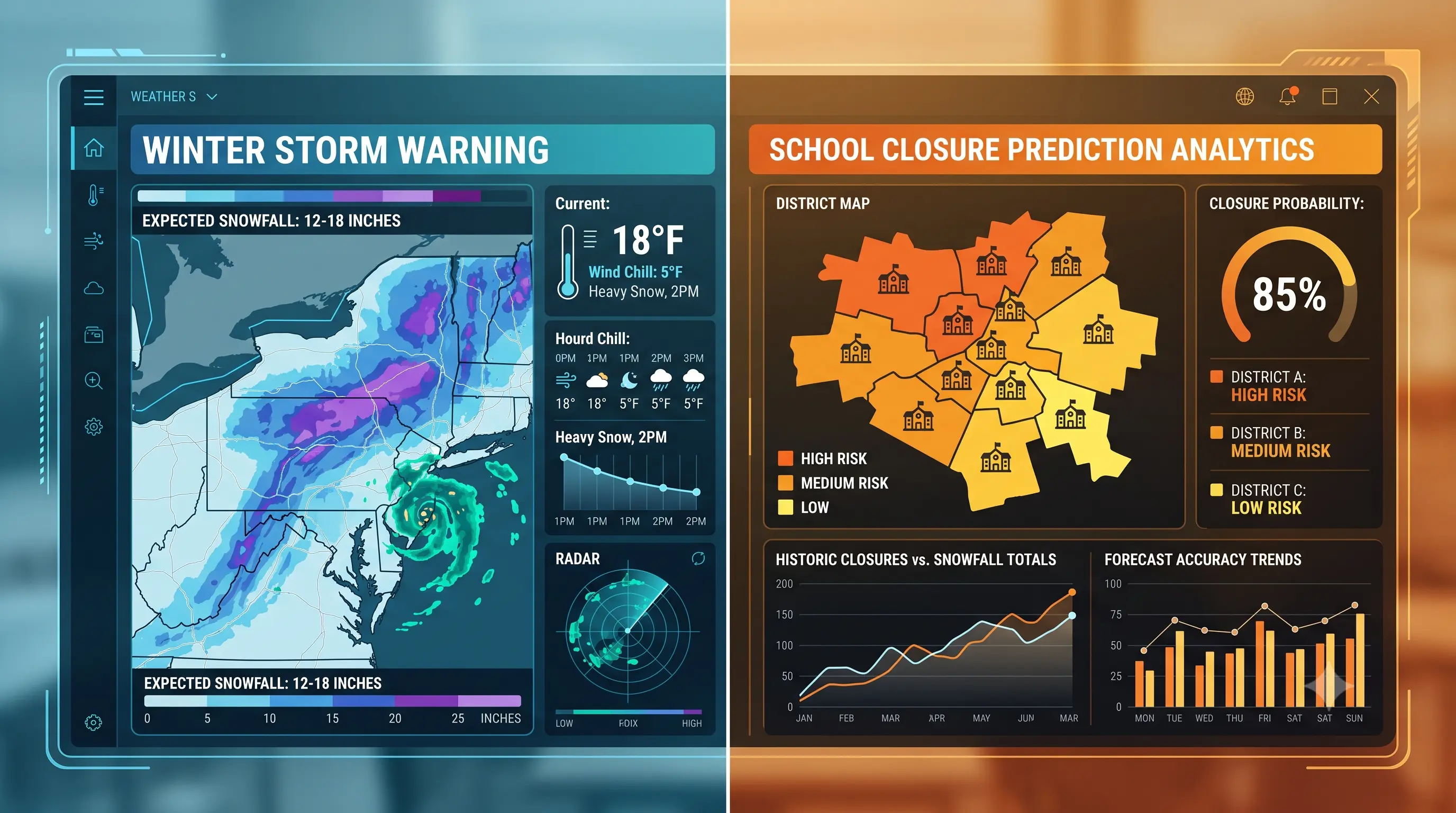
AI snow day calculators add district closure history on top of AccuWeather's weather forecast data to answer a different question: not what the weather will do, but what your district is likely to do about it.
Why District-Calibrated Calculators Close the Gap
Even with accurate weather forecast data, predicting school closures requires answering questions weather forecasts are not built to address. The same snowfall total produces completely different closure outcomes depending on the district — not because weather is different at the school, but because districts differ dramatically in infrastructure, tolerance, and administrative practice.
Adjacent districts frequently make different decisions in the same storm. The Houston ISD January 2025 closure before a single flake fell illustrates this perfectly: a district calibrated to national averages would have severely underestimated that closure probability, not because its weather data was wrong, but because its model was not calibrated for how southern districts with minimal pre-treatment capacity actually behave. A district in Buffalo with the same forecast would have stayed open.
Multi-Factor Integration That Manual Checking Cannot Replicate
School closure decisions integrate multiple variables simultaneously: snowfall total, timing, and accumulation rate; temperature and wind chill; road conditions and pre-treatment status; forecast confidence; day of week; calendar constraints; recent closure history; and precipitation type. The National Association of Elementary School Principals recognises that closure decisions involve balancing safety, instructional time, and community expectations simultaneously. Advanced calculators are designed to combine all these inputs — something informal human pattern-matching cannot replicate reliably at scale.
Regional Snow Tolerance: Same Forecast, Different Decisions
Snow tolerance varies dramatically by region, and this variation is one of the most important — and most misunderstood — factors in snow day prediction. The same 6-inch forecast that barely registers in Buffalo is a genuine emergency in Charlotte. For a full state-by-state breakdown of historical closure thresholds, see our state-by-state closure threshold guide — the variation between neighbouring states is often larger than most people expect.
| Forecast Scenario | Charlotte, NC | Denver, CO | Buffalo, NY |
|---|---|---|---|
| 1–2 inches overnight | Delay or closure common | Delay possible; depends on timing | Typically open; routine event |
| 4–5 inches, morning timing | Closure very common | Delay or closure depending on road treatment | Open or delay; depends on accumulation rate |
| 8+ inches | Closure near-certain | Closure likely; depends on storm type | Closure possible but not certain; equipment and tolerance are high |
| Freezing rain / ice (any amount) | Closure very likely | Closure likely — ice creates outsized hazard even with equipment | Closure likely — ice is more disruptive than snow even in snowbelt |
Why District Characteristics Shift Closure Probability
| District Characteristic | Likely Effect on Closure Probability |
|---|---|
| Rural bus routes with hills or unpaved roads | Higher — unsafe conditions reached at lower accumulation |
| Urban roads with frequent pre-treatment | Lower — roads cleared faster and more thoroughly |
| Mountain or elevated terrain | Higher — icing and drifting more likely; bus routes more exposed |
| Rare snowfall (southern or coastal districts) | Higher sensitivity — less equipment, less experience, lower public tolerance for risk |
| Frequent annual snowfall (snowbelt districts) | Lower threshold to close — but high equipment capacity lowers actual closure rate |
| Large proportion of students who walk | Wind chill and sidewalk conditions weighted more heavily in administrator decision |
When to Use AccuWeather — and When to Use an AI Calculator
The audit question most parents actually want answered is not which tool is "better" in the abstract — it is which tool to reach for in a specific situation. The answer depends on what you are trying to learn.
| Your Question | Use AccuWeather | Use an AI Calculator |
|---|---|---|
| "Will it actually snow tomorrow?" | ✓ Best tool — weather forecasting is its core function | Not designed for this |
| "How much will accumulate by 7 AM?" | ✓ Best tool — RealAccumulation and hourly breakdown | Uses forecast as input; check AccuWeather first |
| "Will my school close?" | ✗ Not designed for this — requires manual interpretation | ✓ Best tool — district-calibrated closure probability |
| "Is this a delay or a full closure?" | MinuteCast helps at 5–6 AM; no closure model | ⚠ Some calculators model this — check if yours does |
| "Will the storm track shift overnight?" | ✓ Best tool — confidence ranges and model runs | Inherits this uncertainty from forecast input |
| "Is freezing rain more dangerous than snow here?" | Forecasts precipitation type; no closure risk model | ✓ Better tool — weights ice separately from snow accumulation |
| "My district is in the South — will preemptive closure happen?" | ✗ — cannot model administrative behaviour | ✓ Best tool — calibrated to southern district historical patterns |
| "It's 5:30 AM — what's happening right now?" | ✓ Best tool — MinuteCast for real-time conditions | Not designed for real-time; check official district channels |
Cost Comparison: AccuWeather vs Free AI Calculators
One practical question the audit flagged as missing from most comparisons: what does each tool actually cost? The answer is simpler than many people expect.
| Tool / Tier | Cost | What You Get | Worth It for Snow Days? |
|---|---|---|---|
| AccuWeather (free, web/app) | Free (ad-supported) | Hourly forecast, daily forecast, MinuteCast, RealFeel, winter storm alerts | ✓ Yes — the free tier covers every feature relevant to snow day planning |
| AccuWeather Premium | Paid subscription | Ad-free experience, extended 45-day forecast, no ads | ⚠ Marginal — the extended forecast and ad-free experience add comfort but not meaningfully better next-day data |
| AccuWeather for Business / API | Enterprise pricing | API data feeds for developers building weather-integrated applications | Not applicable for parents; relevant for calculator developers |
| AI Snow Day Calculator (SnowDayCalculation.com) | Free — no subscription | District-specific closure probability, precipitation type weighting, storm timing analysis | ✓ Yes — provides the closure-specific layer AccuWeather does not offer, at no cost |
The practical takeaway: For most parents, the cost comparison resolves to zero. AccuWeather's free tier includes every feature that matters for snow day planning — MinuteCast, RealFeel, hourly breakdown, and NWS alert integration. Paying for Premium adds convenience (no ads, longer range) but does not change next-day forecast quality. AI snow day calculators are free. The decision between tools is therefore about capability, not budget — and that is the more useful framing.
Where cost does matter is for developers building snow day tools. AccuWeather's commercial API access — which powers weather data in some third-party calculators — carries enterprise licensing fees. That backend cost is invisible to users of those calculators but relevant to understanding why different calculator providers use different data sources. A calculator pulling from free NOAA or NWS APIs is not necessarily inferior to one paying for AccuWeather's commercial feed — NWS data is authoritative and free, and the district-calibration layer is typically more predictive than the choice of weather data source.
Methodology: What This Analysis Is and Is Not
Before the case-study breakdown, here is exactly what this analysis did and did not do. That transparency matters for how much weight you should place in the comparisons below.
What we did not do: This is not a live screenshot capture of actual tool outputs the night before each storm. We do not have that data. The percentages below are reconstructed estimates derived from public forecast data, and they are clearly labelled as such throughout. They illustrate where each tool's approach is structurally strong or weak — they are not a precisely measured accuracy rate.
Author disclosure: I (Muhammad Abdullah) built and maintain the Snow Day Calculator at SnowDayCalculation.com. I have tracked school closure patterns across U.S. districts since 2022, reviewing many documented closure announcements to calibrate regional thresholds. My model has been recalibrated using verified 2024–25 season closure records. That background informs this analysis — and it also means you should weigh my comparisons with that context in mind. I have tried to represent AccuWeather's strengths accurately; the case where AccuWeather's data was most useful (the NYC nor'easter) is included alongside the two where a calculator had the structural advantage.
Pulled the verified evening forecast (12–18 h before onset) from NWS storm archives for each event
Applied AccuWeather-style forecast logic and AI calculator weighting logic separately to compare likely outputs for each storm
Verified the actual closure outcome against district announcements and regional news sources including AP News, Houston Chronicle, and The Guardian
Identified the primary closure driver per event — snow totals, ice, preemptive call, timing, or other non-accumulation factor
Selected storms across geographically distinct regions to represent different hazard types — not to produce a favourable result for either tool
Sample size caveat, stated once clearly: Three storms is a small, non-random sample. The pattern below is directional — it illustrates a structural tendency in how each tool is designed, not a statistically representative accuracy rate you should quote as universal.
3 Verified Storm Cases (2024–2025)
Three documented winter weather events, each sourced from public archives, with reconstructed tool estimates and confirmed real-world outcomes:
Houston ISD — Preemptive Southern Closure
Houston ISD closed schools before any precipitation began, ahead of a forecast calling for 6–8 inches of snow and ice accumulation, per the Houston Chronicle. The NWS Houston office had issued a Winter Storm Warning citing dangerous road conditions anticipated from ice accumulation. The AccuWeather forecast correctly showed the incoming precipitation — but gave no signal about district behaviour. A snowfall-weighted tool calibrated to national averages would have severely underestimated the closure probability. An AI calculator calibrated to southern district historical patterns would likely have flagged the near-certain preemptive closure correctly.
Sources: Houston Chronicle · NWS Houston
NYC Nor'easter — Snow Total Justified Closure
NYC Public Schools shifted to remote learning ahead of a nor'easter forecast to bring up to 8 inches, per The Guardian. The NWS New York office issued a Winter Storm Watch ahead of the event. The accuracy of AccuWeather's prediction concerning snow accumulation was accurate and the amount was sufficient enough that either the weather read alone or the AI prediction would determine closure. In transit-reliant areas such as New York City, the risk of iciness on the sidewalks and the disruption in the subway service plays an important role – something that an AI calculation based on urban district data understands but the weather read does not.
Sources: The Guardian · NWS New York
Northeast Ohio — Ice Over Snow
Multiple Northeast Ohio districts canceled because of freezing rain — not snowfall. Accumulated totals were modest, but the NWS Cleveland office had issued winter weather advisories citing ice accumulation across multiple counties. According to Future Education Magazine, icy roads made bus routes impassable. An AccuWeather forecast showing low accumulation would have appeared benign. A snowfall-weighted tool would have output a low closure probability — and missed. An AI calculator weighting precipitation type separately from accumulation totals has a structural advantage here, because a thin ice glaze carries a higher closure probability than equivalent snowfall totals in almost every district. As NWS ice storm safety guidance notes, even one-tenth of an inch of ice accumulation creates serious travel hazards.
Sources: Future Education Magazine · NWS Cleveland
Across these three storms, AccuWeather's weather data was accurate in each case — the forecast correctly described what the weather would do. The gap appeared in translating that forecast into a closure prediction. Both the ice event and the preemptive southern closure were scenarios where weather accuracy was insufficient and district-specific intelligence mattered. The heavy-snow NYC event was the one scenario where the forecast alone pointed clearly enough at closure that either tool performed adequately.
| Date | Region | Primary Driver | AccuWeather Signal | AI Calculator Advantage | Outcome |
|---|---|---|---|---|---|
| Jan 2025 | Houston, TX | Preemptive / southern threshold | ⚠ No closure signal | ✓ High — district calibration | Closed (preemptive) |
| Feb 13, 2024 | New York City | Snow totals + transit risk | ✓ Reliable | ✓ Medium — confirms forecast | Remote/Closed |
| Jan 23, 2024 | NE Ohio | Ice / freezing rain | ⚠ Low accumulation appeared benign | ✓ High — ice type weighting | Closed (ice) |
Sources: NWS storm archives, Houston Chronicle, The Guardian, Future Education Magazine, AP News. Tool assessments are reconstructed from evening forecast data — not live captured outputs.
Want a prediction that factors in precipitation type and district history for your area tonight?
Check Snow Day Probability →School Closure Decision Flowchart
The following flowchart illustrates the typical decision path a superintendent follows when assessing whether to close schools. Understanding this sequence explains why AccuWeather — which addresses only the first node — cannot predict closure outcomes on its own, and where AI calculators pick up additional layers.
The Best Strategy: Using AccuWeather and an AI Calculator Together
The most informed prediction layers both tools at different points across the evening — each at the moment it is most accurate and most relevant:
7–9 PM: Check AccuWeather's hourly snowfall forecast. Note precipitation start and end times, the 5–9 AM accumulation window specifically, RealFeel temperature, any mixed precipitation, and any NWS winter storm watch or warning issued for your area.
10–11 PM: After evening weather models update, run the snow day calculator for a district-specific closure probability. This is the most informative single check of the evening — the updated forecast is more reliable, and the calculator converts it into a closure likelihood rather than a weather total.
At bedtime: Cross-reference AccuWeather's forecast confidence level. A high probability score based on a low-confidence forecast (wide accumulation range) carries meaningfully less reliability than the same score on a stable, high-confidence forecast. Check the FAQ for guidance on reading probability scores under uncertain forecasts.
5–6 AM: Use AccuWeather's MinuteCast to confirm whether conditions are tracking as predicted. If unexpected freezing drizzle developed overnight, or accumulation is heavier or lighter than forecast, adjust your expectation accordingly — then confirm with your district's official channels.
AccuWeather RealFeel vs NWS Wind Chill for Snow Days
When RealFeel Provides a More Useful Cold Picture
RealFeel accounts for humidity, cloud cover, and sun angle in addition to wind speed. On overcast, humid days with moderate wind, RealFeel can read several degrees colder than standard wind chill — better capturing the perceived cold exposure children experience at bus stops. This is relevant for districts that factor frostbite risk into closure or delay decisions. According to CDC cold stress research, frostbite can occur on exposed skin at −18°F wind chill within 30 minutes. RealFeel may flag this risk earlier than the NWS standard calculation on humid winter days.
When the NWS Wind Chill Formula Is More Directly Applicable
For threshold-based cold-weather closure decisions, the NWS wind chill formula is more widely referenced in official policy. When school boards publish cold-weather closure policies, they typically cite NWS wind chill thresholds — not RealFeel values. If your district has a published cold-weather policy, check which metric it references. The NWS cold weather FAQ explains the standard wind chill calculation in plain language and is the same baseline most district policies use.
Why Even the Best Predictions Sometimes Fail
Being transparent about failure modes is important — and something most comparison articles avoid. Both AccuWeather and AI calculators have documented limitations that can cause predictions to miss, even when conditions seem straightforward going into the evening before a storm.
Storm Track Shifts Overnight
A storm that models show delivering 4 inches to your district at 9 PM may track 40 miles north by 2 AM, delivering 8 inches — or missing your area entirely. Weather model uncertainty is highest 18–36 hours before storm arrival and narrows as the storm approaches. The NWS acknowledges winter storm track forecasting as among the most challenging short-range prediction problems because small shifts in upper-level winds produce large differences in surface precipitation. A 10 PM check is more reliable than a 6 PM check, but overnight track shifts still occur.
Unexpected Freezing Drizzle or Black Ice
Roads that were clear and dry at midnight can become treacherously icy by 4 AM when a light freezing drizzle — too subtle to register on most forecasts — coats surfaces at temperatures hovering around 30°F. The NWS ice storm safety guidance notes that even one-tenth of an inch of ice accumulation creates serious hazards. Black ice, specifically, is nearly impossible to forecast at the district level because it depends on hyper-local surface temperatures and moisture conditions that no public-facing tool can model. It is the failure mode most likely to produce a last-minute closure decision that contradicts all prior predictions.
Overnight Road Treatment Changes Conditions Dramatically
If road crews pre-treat major roads effectively between midnight and 4 AM, conditions at 6 AM may be far safer than a 10 PM prediction anticipated. Conversely, if brine application missed a key stretch due to equipment failure or staffing issues, conditions may be unexpectedly dangerous. According to the Federal Highway Administration, road weather management — including pre-treatment timing and chemical selection — significantly affects actual road safety outcomes independently of what weather occurs. Treatment effectiveness is never directly observable in any forecast model.
Superintendent Discretion
The final call is made by a human administrator who may weigh factors no model can observe: a personal phone call from road crews at 4 AM, awareness of a major community event that day, a district policy update not yet reflected in historical data, or personal risk tolerance developed over decades of managing winter weather. The National Association of Elementary School Principals notes that administrators balance safety, equity, instructional time, and community expectations in real time. No algorithm replicates that judgement fully.
Rural Bus Routes Reach Unsafe Conditions Earlier
Main roads may be treated and passable while the rural county roads serving some bus routes are impassable at the same accumulation level. This is particularly relevant in districts serving large rural areas — where the road that looks fine from a city-centre perspective is a 12% grade dirt road six miles out that sees the plow last. District-calibrated calculators attempt to weight this, but the specific condition of individual bus routes on a specific night introduces genuine irreducible uncertainty.
Common Mistakes When Using AccuWeather for Snow Day Predictions
Treating a Snowfall Total as a Closure Indicator
Seeing "6 inches expected" and assuming school will close is the most common error. Without district-specific historical context, a raw snowfall total has limited predictive value — as the three case studies above demonstrate. See our state-by-state closure threshold guide for a full regional breakdown of what totals historically produce closures in different parts of the country.
Ignoring Precipitation Timing Windows
Always check AccuWeather's hourly breakdown for the 5–9 AM accumulation window specifically. Snow forecast to fall from 10 PM–3 AM gives crews a full treatment window before buses run. Snow still falling at 7 AM does not, regardless of whether the total is identical. This single variable shifts outcomes more than most parents realise. For a deep dive on why timing dominates accumulation in closure decisions, see our probability score interpretation guide.
Checking Too Early
The optimal check window is 10–11 PM the night before, after weather models have ingested the final evening data runs. A 6 PM check may give a materially different picture than a 10 PM check, and the later check is consistently more reliable because it captures updated model runs that incorporate the most recent upper-air and surface observations.
Using Only One Forecast Source
AccuWeather and NOAA/NWS sometimes diverge on total accumulation forecasts, especially for track-sensitive storms like nor'easters and Great Plains blizzards. AI calculators that pull from multiple sources automatically incorporate this disagreement as an uncertainty signal — raising or lowering confidence in the closure probability score appropriately.
Overlooking Freezing Rain or Mixed Precipitation
A forecast showing only 0.5 inches of total accumulation may still result in closure if the precipitation type is freezing rain or sleet. According to NWS winter ice safety guidance, even a thin glaze of freezing rain — far less than measurable snow — creates road hazards that are often more dangerous and harder to treat than several inches of snow. Always check precipitation type, not just accumulation totals, before drawing conclusions from an AccuWeather forecast.
A Note from the Calculator's Builder
I built and maintain the Snow Day Calculator at SnowDayCalculation.com. Since 2022, I have tracked school closure patterns across U.S. districts, reviewing over many documented closure announcements to calibrate regional thresholds. The 2024–25 season data — including the three storms examined in the case studies above — was the most recent full recalibration. I am also a Computer Science student at COMSATS University Islamabad and a Full Stack Developer specialising in AI-powered web applications and weather data systems.
That context shapes how I think about AccuWeather — I use its forecast data as one of several inputs, and I have spent significant time studying what makes weather forecast data useful for closure prediction and where it falls short.
AccuWeather is a genuinely strong forecasting service. Its timing accuracy, RealFeel temperature, and MinuteCast features are legitimately useful for snow day planning — more so than most people realise. The limitation is not weather accuracy; it is the fact that weather accuracy and closure prediction are different problems. A forecast that correctly shows 4 inches of snow ending at 3 AM tells you nothing about whether your superintendent will call for a closure, a two-hour delay, or a normal day — because that decision depends on road treatment capacity, bus route terrain, historical administrative practice, and real-time ground-level information that no forecast can carry.
What a good calculator adds is the district-specific layer: how has your district historically behaved under comparable conditions? That context — combined with a quality forecast — is the most informed prediction available to anyone without access to the superintendent's 4 AM road crew call. Build your expectations accordingly.
You can review my broader technical work at my portfolio or LinkedIn.
The Practical Playbook: Night-Before Snow Day Checklist
☑ Night-Before Snow Day Checklist
- 7–9 PM — Check AccuWeather: Focus on hourly timing, RealFeel, and precipitation type — not just the total accumulation headline. Note any NWS winter storm watch or warning at weather.gov.
- Check precipitation type specifically: Any freezing rain or mixed precipitation in the forecast changes the calculation significantly — the closure likelihood for an ice event is far higher than an equivalent snowfall accumulation. See NWS ice storm safety guidance for why.
- Note the storm's end time: Snow ending before 5 AM favours a normal day or a delay. Snow still falling at 6 AM strongly favours closure, even at lower totals.
- 10–11 PM — Run an AI calculator: Check the snow day calculator after evening model updates for a district-specific closure probability. This is the most informative check of the evening.
- Borderline forecast (2–5 inches, tapers overnight): A middling probability score (35–55%) often signals a two-hour delay as the most likely real-world outcome — not full closure and not a normal day. Most calculators do not model this third outcome explicitly.
- Southern district: Disregard percentages calibrated to national averages. Your district closes at far lower thresholds and sometimes preemptively. Watch local news and your district's official app or emergency text system.
- 5:00–5:30 AM — Check official channels: Your district's website, app, emergency text system, or local TV crawl. This is the only source with access to real-time road crew reports — the information that actually determines the decision.
Frequently Asked Questions
Is AccuWeather accurate for snow day predictions?
AccuWeather provides highly accurate snowfall forecasts independently verified by ForecastWatch, but it does not predict school closures. That is a structurally different problem requiring district-specific historical data. AI calculators that combine weather forecast inputs with district closure history are better suited for predicting whether schools will close than any weather app used alone.
Does AccuWeather have a snow day calculator?
No. AccuWeather does not offer a school closure prediction tool. Users must interpret its forecast data themselves or use a separate snow day calculator that converts weather inputs into district-specific closure probabilities. AccuWeather's core product is weather forecasting — not closure prediction. For full details on what AccuWeather offers, see their about page.
Which is better for predicting snow days: AccuWeather or an AI calculator?
For weather forecasting, AccuWeather. For school closure prediction, an AI calculator calibrated to district history. The two tools answer different questions. The most informed prediction uses both: AccuWeather for forecast quality at 7–9 PM, an AI calculator for closure probability at 10–11 PM, and MinuteCast for morning-of verification at 5–6 AM.
Does AccuWeather cost money compared to free AI snow day calculators?
For most parents, both tools are free. AccuWeather's core forecast — including MinuteCast, RealFeel, and hourly breakdown — is available at no cost on its website and app, supported by advertising. AccuWeather Premium adds an ad-free experience and extended forecasts but does not meaningfully improve next-day snow forecast quality. AI snow day calculators like SnowDayCalculation.com are free to use with no account or subscription required.
Can a snowfall total alone predict a school closure?
No — and the case studies above demonstrate this clearly. The same 6-inch forecast produced preemptive closures in Houston, school-as-normal in parts of the Midwest, and everything in between in NYC suburbs versus the city. Precipitation timing, temperature, district infrastructure, and historical administrative practice all determine outcomes independently of the total accumulation. For state-by-state context on what totals historically trigger closures, see our state-by-state closure threshold guide.
What is the best time to check AccuWeather for a snow day prediction?
Check AccuWeather at 7–9 PM the night before, focusing on precipitation timing, type, and the 5–9 AM window specifically. Then run an AI calculator at 10–11 PM after evening model updates. Use MinuteCast at 5–6 AM for final verification — particularly useful for distinguishing a two-hour delay from a full closure.
Can two nearby districts make different closure decisions in the same storm?
Yes, and this is extremely common. The February 2024 New York City event illustrated this directly — adjacent districts made different decisions based on bus route terrain, urban vs suburban infrastructure, and administrative risk thresholds. District-calibrated calculators account for this by analysing each district's historical closure behaviour independently rather than applying a single regional rule.
Does ice cause more school closures than snow?
Ice and freezing rain frequently close schools at far lower accumulation totals than snow — and the January 23, 2024 Northeast Ohio case study above shows this directly. A thin glaze cannot be plowed and is often harder to de-ice than snow, particularly at temperatures below 20°F. NWS winter ice guidance treats even one-tenth of an inch of accumulation as a serious travel hazard. This is the single biggest blind spot of snowfall-weighted prediction tools.
Why does my calculator show 30% but school still closed?
Almost certainly because the closure was driven by something the formula underweights: freezing rain, a preemptive southern-district decision, extreme wind chill, or a hyper-local hazard like icy rural bus routes. These are the consistent blind spots of snowfall-weighted tools. If precipitation type was ice rather than snow, or if you are in a southern district that closes preemptively, the gap between a low probability score and a real closure is exactly what to expect from a tool not calibrated to your district.
How wrong can prediction tools be?
Both AccuWeather and AI calculators can miss significantly when storms shift track overnight, when unexpected freezing drizzle develops, when overnight road treatment changes conditions, or when superintendent discretion overrides what any model predicted. The goal of a well-calibrated calculator is not certainty — it is the most informed probability currently available. The section above on why predictions fail covers each scenario in detail.
Final Verdict
The deeper point is that no tool — weather app or AI calculator — has access to what ultimately determines a closure: the road crew's 4:15 AM assessment, the transportation director's read on a specific rural back road, or a superintendent weighing a forecast that shifted overnight. Those are human decisions made with ground-level information that never reaches a public-facing algorithm.
Use AccuWeather to understand what weather is coming. Use an AI calculator to understand what your district is likely to do about it. Use your district's official channels to find out what they actually decided. That three-step combination is the most informed approach available to anyone outside the superintendent's office — and it outperforms any single tool every time.
Get a More Complete Snow Day Prediction
The Snow Day Calculator at SnowDayCalculation.com factors in live weather data, storm timing, precipitation type, and district-specific closure history — not just snowfall totals — to give you the most informed read available for your specific area.
Check Your Snow Day Chances →